Tough On Accessories Review 2026: 4 Best Rugged Picks
A specs-first look at Tough On's rugged phone cases, Qi2.2 wireless chargers, MagFlex car mounts, and 240W USB-C cables, with a buying guide and comparison table.
How Tough On's charging and protection standards actually work
- How Tough On's charging and protection standards actually work
- How to choose the right Tough On accessory for your setup
- Insider tips for getting the most from Tough On gear
- Common mistakes to avoid with chargers, cases and mounts
- The Tough On lineup: four accessories worth a look
- Tough On accessories compared
- Alternatives to consider
- What to look for when buying phone accessories
Tough On accessories cover the everyday gaps in a phone setup: rugged cases, Qi2.2 wireless chargers, MagSafe car mounts, and 240W USB-C cables, all sold by an Australia-based brand that backs most of its lineup with extended warranties. If you have outgrown flimsy cables and slow chargers, this guide breaks down what each product actually does, how the underlying standards work, and which pick fits your setup.
Key Highlights
- Tough On's MagPro charger is Qi2.2 certified for 25W magnetic charging, up from the previous 15W Qi ceiling.
- The brand's 240W USB-C cable uses the USB-IF's PD 3.1 Extended Power Range spec with an E-Marker chip.
- The MagFlex car mount relies on 22 N55 neodymium magnets plus a washable nano-gel suction base.
- Most Tough On products carry a 24-month warranty, with 60-day money-back guarantees on cases and mounts.
- The Armor Core case is not marketed with a formal MIL-STD-810G drop-test certification.
Tough On is a solid pick if you want Qi2.2-era charging speed, MagSafe-grade magnets, and a long warranty without hunting across several separate brands.
Choose Tough On if you want one Australian brand covering your case, charger, mount and cable with a consistent warranty policy. Skip it if you specifically need a third-party-certified rugged case, since Tough On markets “real-world drop tested” protection rather than a MIL-STD-810G rating.
Check Current PriceHow Tough On's charging and protection standards actually work
Tough On accessories lean on a handful of published industry standards rather than marketing buzzwords, which makes it easier to check the claims yourself. On the charging side, Qi2.2 (also called Qi2 25W) is the wireless-charging standard the Wireless Power Consortium released in July 2025, raising the previous 15W ceiling to 25W and using Magnetic Power Profile 2.0 for precise magnet alignment that reduces energy loss. To actually hit 25W, a phone needs a certified Qi2.2 charger paired with a USB-C PD adapter rated 30W or higher, and under optimal conditions that combination can reach roughly 50% charge in 30 minutes.
The magnets doing the aligning matter too. Apple's MagSafe specification requires third-party magnets rated N45SH or higher, and N52 is the same grade Apple uses in its own accessories — it is the highest commercial neodymium grade at 52 MGOe. Lower-grade magnets will still snap on, but with measurably less holding force, which is why Tough On's MagPro charger and MagFlex mount both specify N52-class magnets rather than a generic “strong magnet” claim.
Cables have their own standard: USB Power Delivery 3.1, published by the USB Implementers Forum, adds an Extended Power Range with three new tiers topping out at 48V/5A, or 240W. Hitting that top tier requires an E-Marker chip built into the cable so it can digitally identify its own voltage and current rating to both the charger and the device, and PD 3.1 240W cables stay backward compatible with older PD 3.0 gear (capped at 100W).
Wireless car chargers add a heat problem that wired chargers don't have. Without active cooling, a phone in direct sunlight can exceed 45°C, which triggers thermal throttling and drops output from 25W to 7.5W or lower within 20–30 minutes — a real risk in a parked car, where cabin temperatures can reach 60–70°C. Active-cooling systems use temperature sensors to regulate wattage in real time instead of just cutting power once the phone overheats.
On the protection side, MIL-STD-810G (Method 516.6) is a U.S. military standard covering controlled drop testing: 26 drops across 5 test units, split into corner, edge and face impacts, with units inspected afterward for cracks, dings and bends. It's now widely used as a commercial durability benchmark for phones and cases, though passing it doesn't guarantee protection against every real-world drop. It's worth being precise here: Tough On's product listing for the Armor Core case does not cite a formal MIL-STD-810G certification — it markets “real-world drop tested protection” with reinforced corners and raised edges instead. That's a meaningfully different claim from a certified rating, and worth knowing before you buy if third-party certification is a requirement for you.
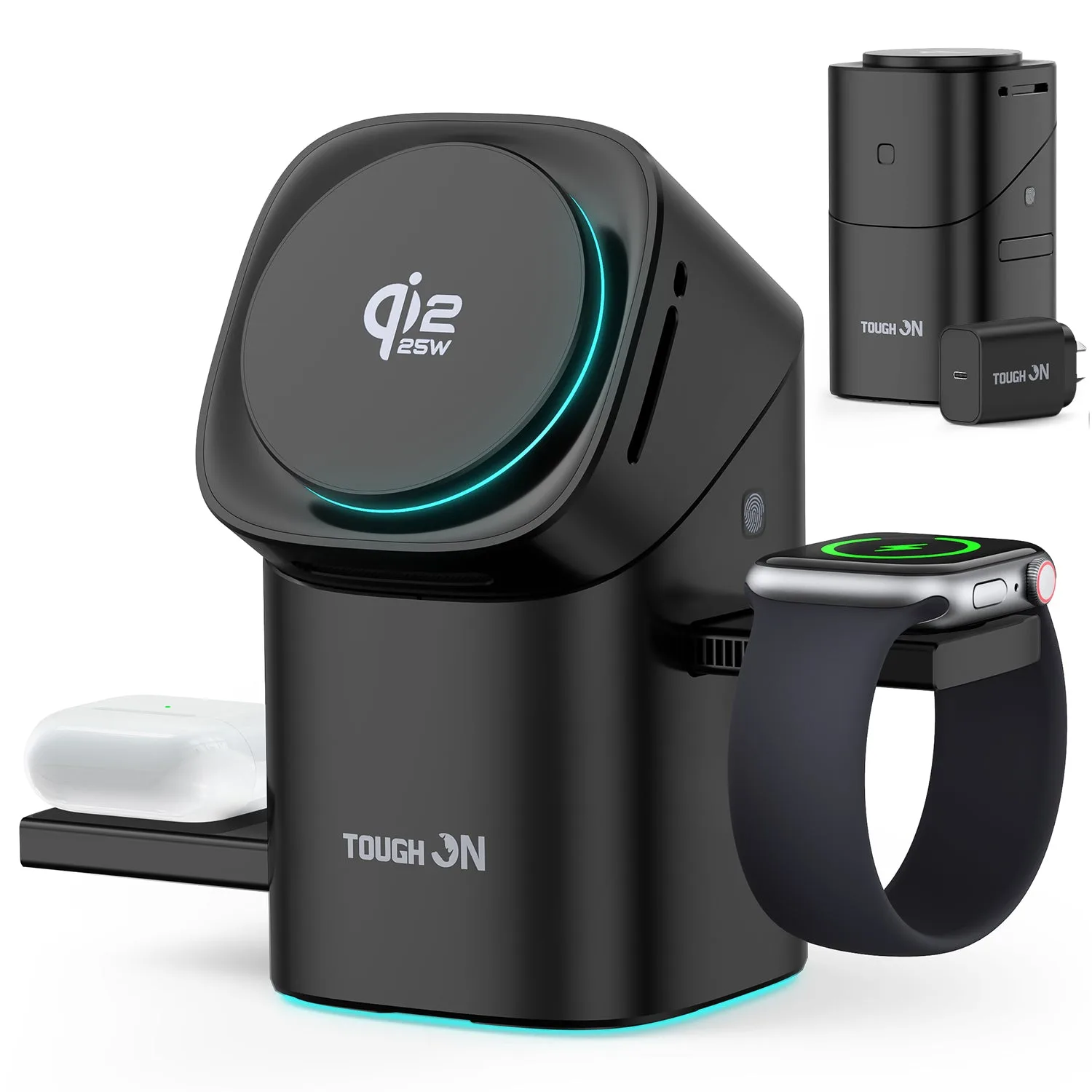
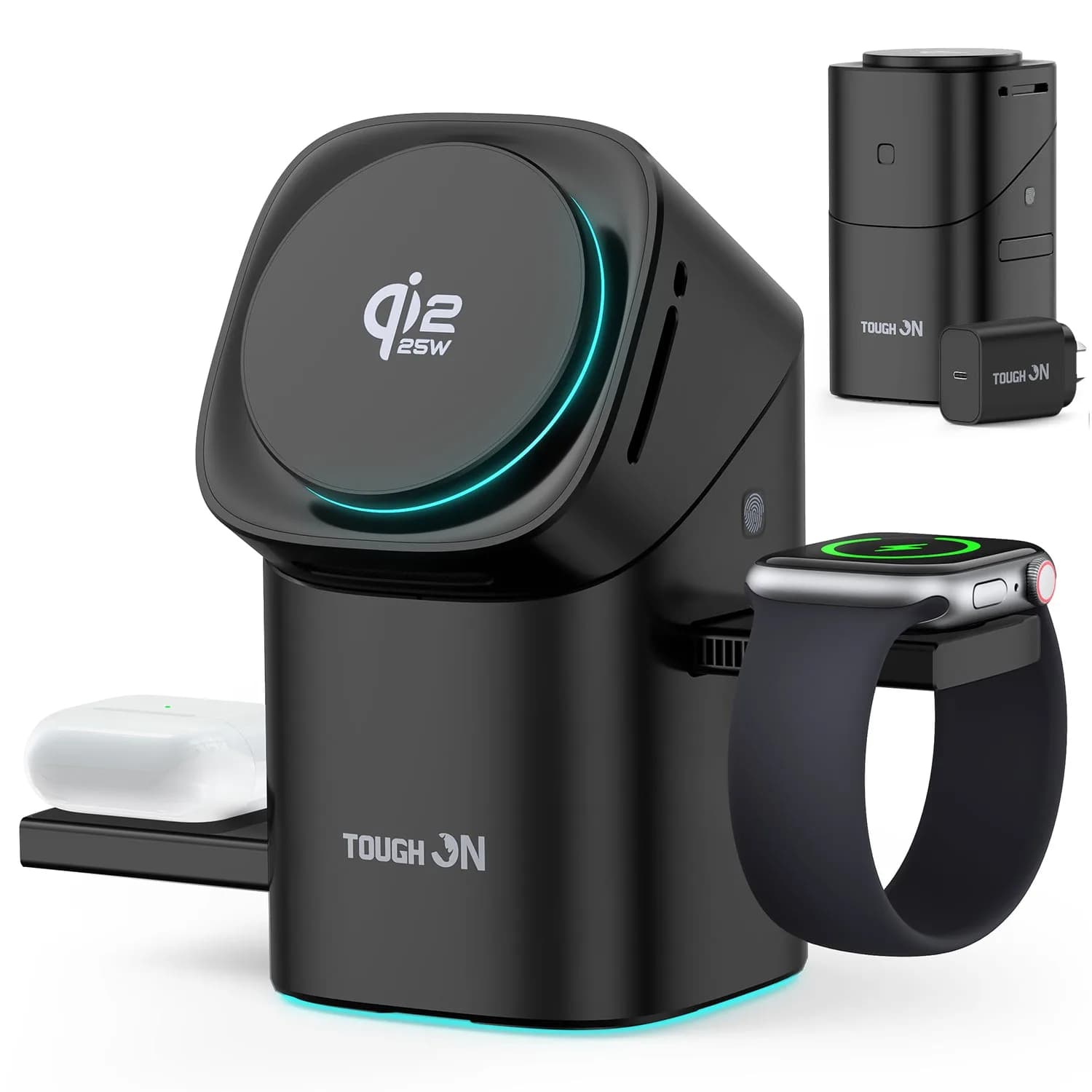
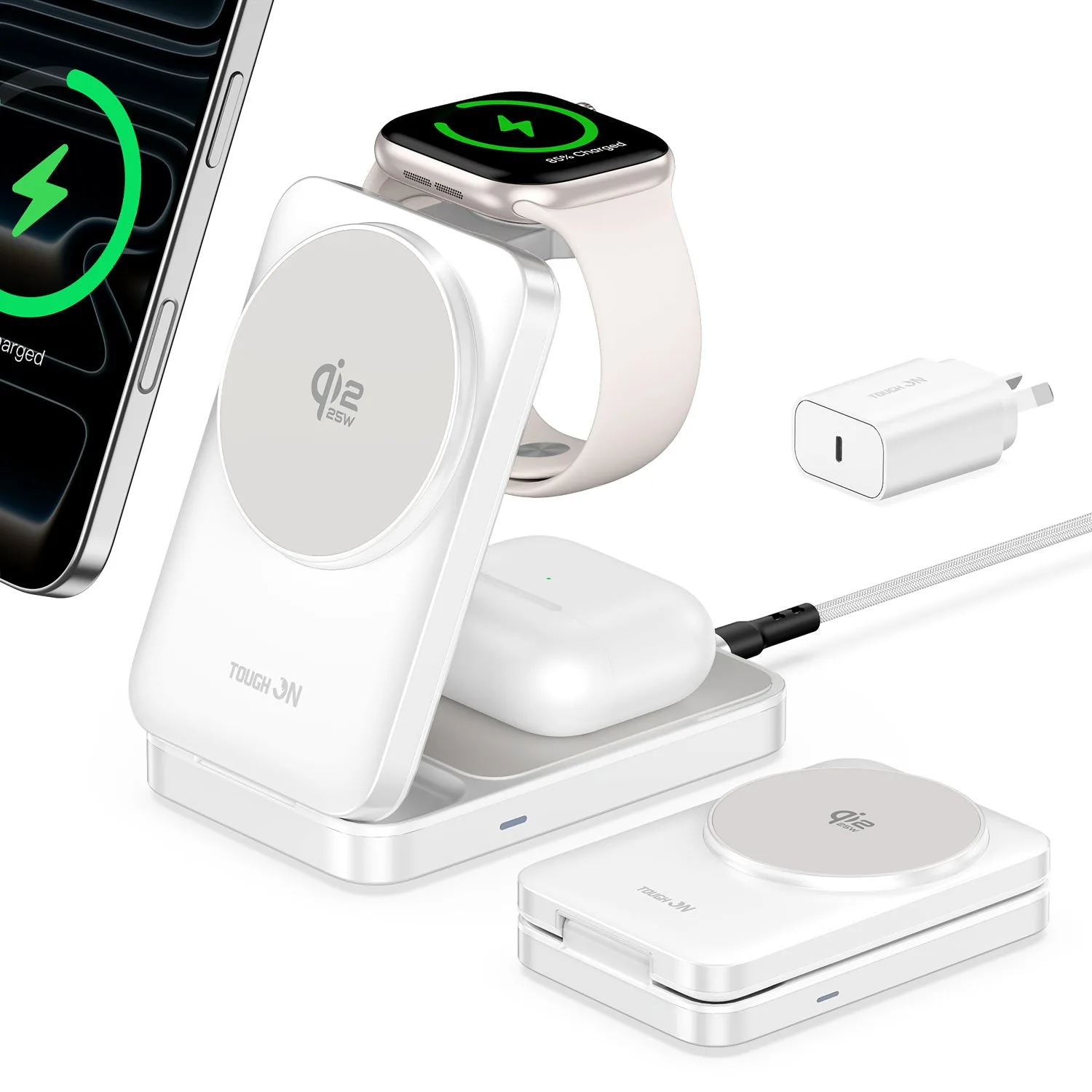
Tough On MagPro Qi2.2 25W 3-in-1 Wireless Charger
Qi2.2 certified for 25W magnetic charging with N52 magnets and an active-cooling system to hold that speed.
How to choose the right Tough On accessory for your setup
Start with the problem you actually have rather than the product that looks most impressive. If your phone regularly slips off a nightstand charger overnight, the case and the charger's magnet alignment matter more than raw wattage. If you drive daily and rely on your phone for navigation, the car mount's holding force and the charger's active cooling matter more than anything else on this list.
For a single desk or nightstand, the MagPro 3-in-1 charger covers a phone, watch and earbuds at once, so you're not juggling three separate cables and bricks. For the car, the MagFlex mount solves the “phone in my lap at a red light” problem with a magnetic dash or windshield attachment rather than a spring-loaded claw that eventually loosens. For everyday drop protection, the Armor Core case's hybrid TPU-and-PC build and reinforced corners are the more relevant spec than a certification badge that isn't actually on the listing. And if your current cable is the bottleneck — slow charging a laptop, a Nintendo Switch or a power bank — the 240W PD 3.1 cable is the one upgrade that touches almost every USB-C device you own.
If you own more than one of these already, prioritize the mount and the cable first: they solve the most friction-filled daily moments (fumbling with a phone while driving, waiting on a slow charge) compared with a case swap, which mostly matters after a drop rather than every single day.
Insider tips for getting the most from Tough On gear
A few details make a real difference in daily use. First, pair the MagPro charger with a PD adapter rated 30W or higher — that's the minimum the Qi2.2 spec needs to actually deliver 25W to a compatible iPhone; a weaker adapter will silently cap your charging speed even though the charger itself supports 25W. Second, if you're charging overnight, look for the charger's silent mode toggle, which disables LEDs and fan noise for bedroom use without affecting the active-cooling protection during the day.
For the car mount, the nano-gel suction base is washable and reusable — dust and oils are the main reason a suction mount loosens over time, so an occasional rinse under warm water restores most of the original holding force rather than needing a replacement. For the 240W cable, remember that hitting the full 240W tier needs a charger and device that both support PD 3.1 Extended Power Range — the cable's E-Marker chip enables that ceiling, but it won't push a device past what its own charger can supply.
Common mistakes to avoid with chargers, cases and mounts
The most common mistake is assuming any MagSafe-labeled accessory aligns the same way. Magnet grade varies by manufacturer, and Apple's own minimum spec is N45SH — accessories using lower grades will still click into place but hold less securely under vibration or lateral pressure, which matters most in a moving car. Second, buyers often blame a charger for “slow charging” when the real bottleneck is the paired power adapter; a 25W-rated wireless charger cannot exceed what a sub-30W PD brick feeds it.
Third, leaving a phone on a wireless car charger in direct summer sun without active cooling is a fast way to trigger thermal throttling, cutting speed from 25W down to 7.5W or lower within half an hour — parking in shade or using a windshield-mounted position out of direct light helps regardless of which charger you own. Finally, don't assume every “rugged” case carries a MIL-STD-810G rating just because the category uses military-style language; check the actual listing, since Tough On's own case page does not cite that certification.
The Tough On lineup: four accessories worth a look
Tough On MagPro Qi2.2 25W 3-in-1 Wireless Charger
What We Like
- Charges three Apple devices from one pad instead of three separate bricks.
- Active cooling is built in rather than an optional add-on.
- A physical mute switch for LEDs and fan noise at night.
What to Consider
- Needs a 30W+ PD adapter to actually reach the full 25W ceiling.
- iPhone-centric layout, so Android multi-device charging is limited.
The MagPro is built around the current Qi2.2 spec rather than an older 15W Qi pad, and it includes the 45W PD adapter and cable needed to approach its rated speed out of the box. The main thing to get right is pairing expectations — 25W is a ceiling under good conditions, not a guarantee on every device.
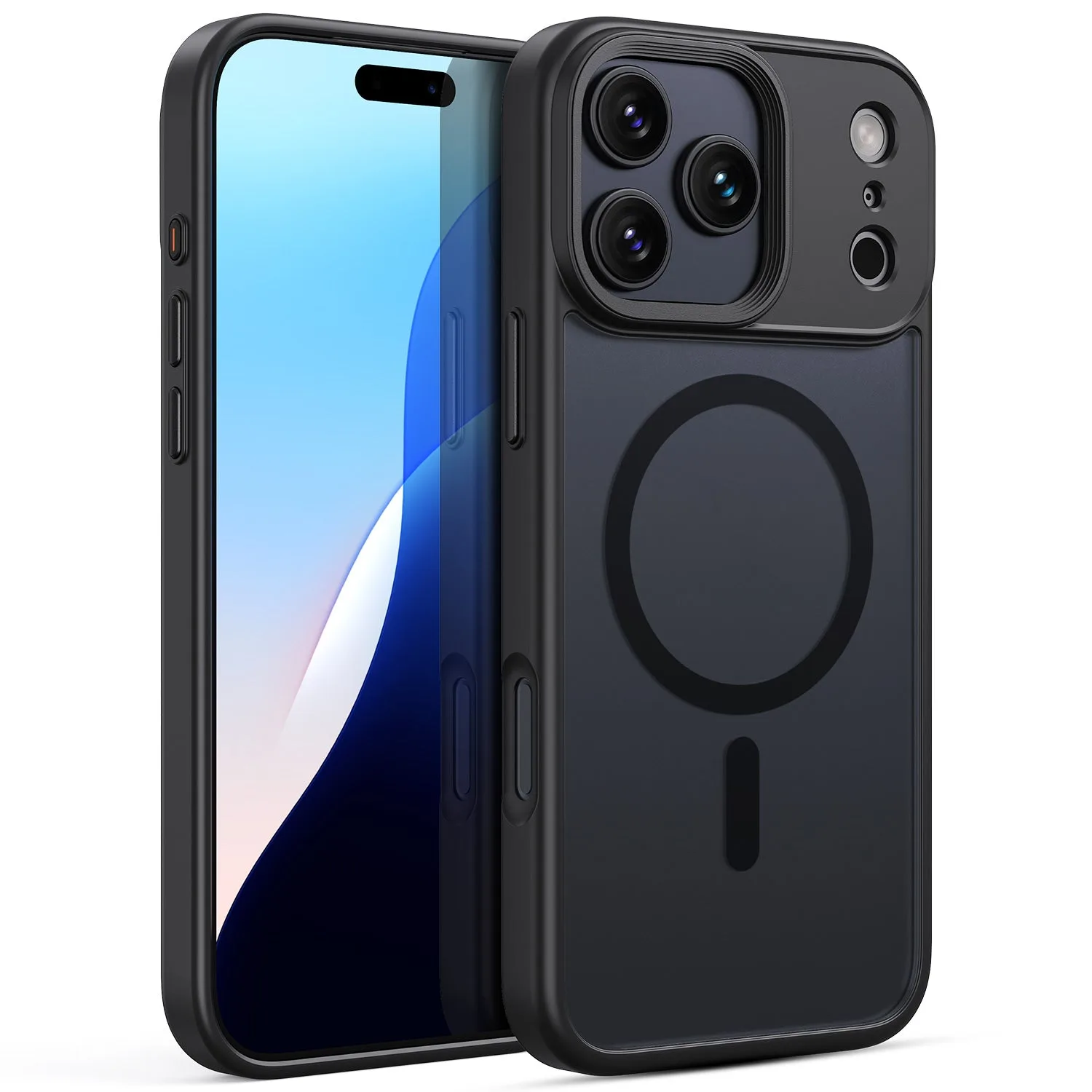
Tough On Armor Core iPhone Case
What We Like
- Full MagSafe compatibility means it works with the MagPro charger and MagFlex mount.
- Reinforced corners target the most common drop point.
- Clear variant stays genuinely clear rather than yellowing marketing claims aside.
What to Consider
- Not marketed with a formal MIL-STD-810G certification — it's “real-world drop tested,” not third-party certified.
The Armor Core case pairs a rigid outer shell with a softer inner layer, which is the standard formula for absorbing rather than transferring impact energy. If a certified drop rating specifically matters to your buying decision, treat that as an open question rather than an assumption — the listing itself doesn't make that claim.
Tough On 240W USB-C PD 3.1 Nylon Braided Cable
What We Like
- One cable spec covers laptops, tablets, phones and handhelds like the Steam Deck or Switch.
- E-Marker chip is what actually unlocks the 240W tier, not just thicker cable marketing.
What to Consider
- 240W only happens if both the charger and device support PD 3.1 EPR — the cable can't add power your charger doesn't supply.
This is the cable to reach for if you're mixing device types — a work laptop, a tablet, and a phone — and want one cable spec that won't bottleneck any of them. The nylon braid and bend-cycle rating target the fraying point most cables fail at first: the connector-to-cable joint.
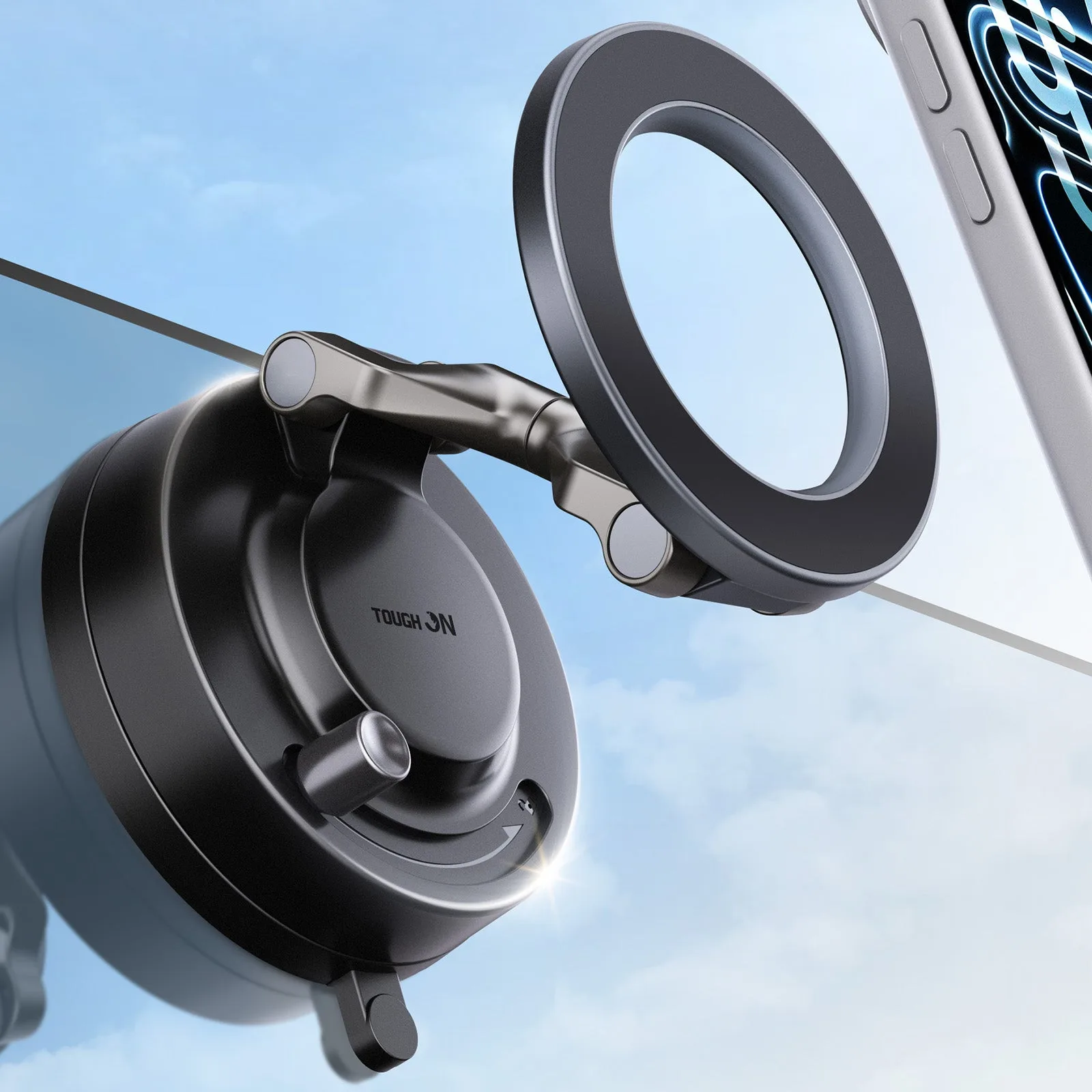
Tough On MagFlex MagSafe Car Mount
What We Like
- Tool-free nano-gel base avoids permanent adhesive damage to the vehicle.
- N55 magnets are a step above the N45SH minimum Apple requires for MagSafe accessories.
What to Consider
- Suction holding force depends on a clean, non-textured mounting surface.
The MagFlex solves the daily friction of getting a phone into a usable driving position without a spring clip that wears out. The nano-gel base being washable is a genuinely practical detail — most suction mounts lose grip permanently once dust builds up, while this one can be rinsed back to near-original tack.
Tough On accessories compared
| Product | Best For | Standard / Compatibility | Standout Feature |
|---|---|---|---|
| MagPro Qi2.2 3-in-1 Charger | Desk or nightstand multi-device charging | Qi2.2, 25W to compatible iPhones | Active cooling plus True Silent Sleep Mode |
| Armor Core iPhone Case | Everyday drop protection | iPhone 11–17 series, MagSafe compatible | Hybrid TPU + PC shell with reinforced corners |
| 240W USB-C PD 3.1 Cable | Laptops, tablets and fast phone charging | PD 3.1 EPR up to 240W, E-Marker chip | 45,000+ rated bend cycles |
| MagFlex Car Mount | Daily driving and navigation | iPhone 12–17, magnetic Android cases | 22 N55 magnets, washable nano-gel base |
Alternatives to consider
Tough On is not the only brand building around Qi2.2 and MagSafe-grade magnets, and it's worth knowing where the category overlaps. If your priority is the mounting hardware specifically — phone, tablet or dash-cam mounts across a modular system rather than one fixed car mount — our iBOLT Mounts guide covers a brand built entirely around swappable, modular mount bases, which suits drivers who move a phone between a car, a bike and a desk stand.
If Tough On's specific SKU doesn't fit your phone model or you want to compare a rugged case against other reinforced-corner designs before buying, treat magnet grade (N52 vs the N45SH Apple minimum), warranty length, and whether MIL-STD-810G is actually claimed on the listing as your three comparison points across any brand — not just marketing language like “military-grade.”
What to look for when buying phone accessories
Check the magnet grade, not just the MagSafe label
“MagSafe compatible” on a listing doesn't tell you the magnet grade. Apple's own spec floor for third-party accessories is N45SH, and N52 is the top commercial grade Apple uses in its own gear — the difference shows up as holding force under vibration, which matters most in a car mount and least on a desk charger. If a listing states the grade, that's a good transparency signal regardless of brand.
Confirm the actual charging standard and wattage path
A charger's peak wattage is only reachable with the right paired adapter — Qi2.2's 25W ceiling needs a 30W+ PD brick, and PD 3.1's 240W ceiling needs both ends of the connection (charger and device) to support Extended Power Range, not just the cable. Read the fine print on “up to” wattage claims before assuming your specific device will hit that number.
Read certification claims literally
“Military-grade” and “drop tested” are marketing phrases; MIL-STD-810G is a specific, named test protocol with a defined drop count and inspection criteria. If a listing doesn't cite the standard by name, treat the durability claim as the brand's own internal description rather than a third-party-verified rating, and weigh that against your own risk tolerance.
How We Chose
We reviewed Tough On's published specifications for each accessory against the primary technical standards bodies behind them — the Wireless Power Consortium for Qi2.2, the USB Implementers Forum for PD 3.1, and third-party documentation on MagSafe magnet grading and MIL-STD-810G drop testing — rather than relying on marketing copy alone.
The Bottom Line
Tough On is a reasonable one-stop pick if you want Qi2.2 charging, MagSafe-grade magnets and a long warranty across your case, charger, mount and cable — just don't assume the case carries a certified drop rating it doesn't claim.
Shop Tough On AccessoriesReferences
- Wireless Power Consortium. Qi2.2 wireless charging standard.
- USB Implementers Forum. USB Power Delivery 3.1 specification.
- MagBak. N52 magnets explained: why magnet grade actually matters.
- SafeSleeve Cases. MIL-STD-810G military-grade drop testing explained.
- Belkin. Active cooling in 25W Qi2 wireless charging.
Recommended for you
 TerraMaster NAS Review 2026: Best F-Series Model for Your Setup
 BeaverKeys Review 2026: Best Affordable Keyboard Store?
 Goblintechkeys Review 2026: Custom Keycaps & Keyboards
 Dopesplay Lapdock Review 2026: Best Phone-to-Laptop Setup?
 Level 2 EV Charger Guide: How to Pick the Best One (2026)
 EVIQO EV Charger Review 2026: Worth Buying? Full Guide