EVIQO EV Charger Review 2026: Is This Smart Level 2 Charger Worth It?
The EVIQO EV charger lineup covers J1772 and NACS, plug-in and hardwired, all with WiFi app control and a 3-year warranty. Here's the honest breakdown before you buy.
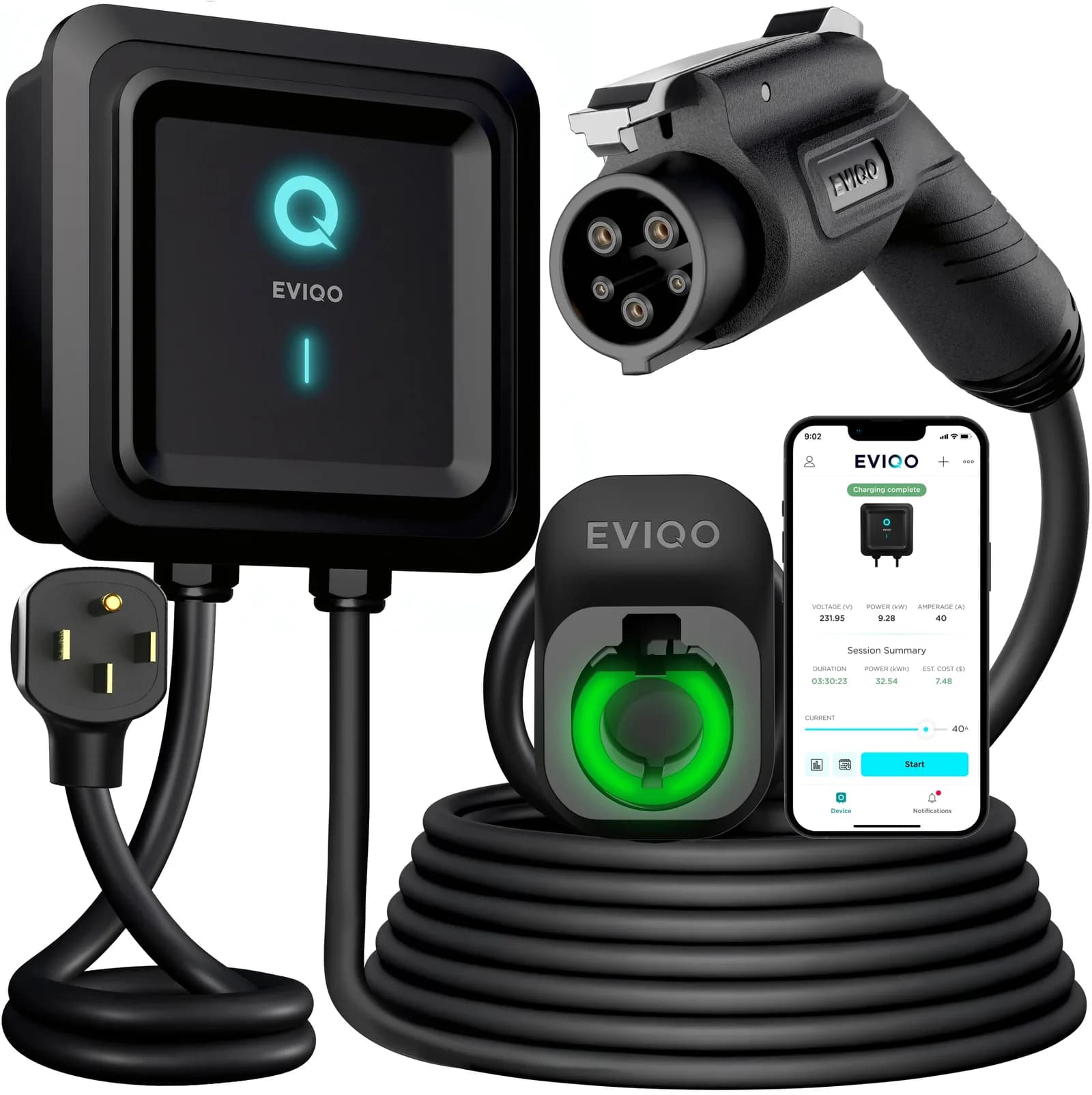
What the EVIQO EV Charger Lineup Includes
The EVIQO EV charger lineup — sold under the EVIPOWER brand — covers five Level 2 home charging models spanning both J1772 and NACS (Tesla) connectors, in plug-in and hardwired formats. If you're comparing home chargers and trying to figure out which Eviqo model actually fits your car, your outlet, and your budget, this guide breaks down the real specs, certifications, and trade-offs — no hype, no guesswork.
A well-certified, feature-complete Level 2 charger line with a model for almost every home setup
If you already have a NEMA 14-50 outlet, a plug-in Eviqo model gets you charging fast and cheap. If you're building a new circuit or want the most permanent, weatherproof setup, the hardwired version is the safer long-term bet. Either way, every Eviqo charger ships with the same certifications, app, and 3-year warranty.
Check Eviqo PricingKey Highlights
- Five models cover J1772 and NACS (Tesla), plug-in and hardwired, 40A-48A.
- Customer ratings run 4.91-4.97 out of 5 across all five models (65-876 verified reviews each).
- Every model carries UL, CSA, ETL, Energy Star, and FCC certification plus a 3-year warranty.
- WiFi app control, 10 independent protection systems, and an IP66 weatherproof enclosure come standard.
- Eviqo chargers received the 2026 Red Dot Award for design excellence.
What the EVIQO EV Charger Lineup Includes
Eviqo, sold under the EVIPOWER brand, manufactures a complete Level 2 EV charger line: five models spanning J1772 (non-Tesla) and NACS (Tesla) connectors, in both plug-in and hardwired configurations, rated 40A-48A. That range matters because it means the same brand can serve a renter who just needs a NEMA 14-50 plug-in unit and a homeowner installing a permanent hardwired charger for a new EV — without switching manufacturers.
Every model in the Eviqo lineup shares the same core hardware: WiFi app control, an IP66 weatherproof enclosure, 10 independent protection systems, and a 3-year manufacturer warranty. The differences come down to connector type, amperage, and how you plan to install it — which is exactly what the rest of this guide walks through.
Eviqo J1772 Plug-In 40A
9.6 kW output with a 25-foot cable — the simplest entry point if you already have a NEMA 14-50 outlet.
Plug-In vs Hardwired: Which One Fits Your Home
This is the first real decision every Eviqo buyer has to make, and it's less about the charger and more about your electrical panel. Hardwired chargers are permanently sealed into the circuit, which eliminates wear from repeated plugging and unplugging and makes them more reliable in harsh outdoor conditions. Plug-in chargers, on the other hand, offer flexibility — you can take them with you if you move, and cable strain at the connection point is the main long-term wear point to watch.
Installation cost is where the two paths really diverge. A licensed electrician typically charges well over a thousand for hardwired labor alone — covering breaker installation, wire runs, permits, and inspection — not including the charger itself. If your home already has a compatible NEMA 14-50 outlet (often left over from an electric range or dryer), a plug-in install is far cheaper: usually just mounting brackets and a safety check. If that outlet doesn't exist yet, expect it to add meaningfully to the plug-in cost, and a panel upgrade (needed in roughly one in five homes) adds even more on top.
One practical note: plug-in chargers can occasionally trip nuisance faults if both the charger's internal GFCI and a breaker-level GFCI sit on the same circuit — worth flagging to your electrician before installation day.
The Eviqo Model Lineup Explained
Eviqo's five models break down into two connector families and two installation types. The J1772 line covers most non-Tesla EVs; the NACS line is built for Tesla and newer NACS-compatible vehicles. Here's how the two most popular configurations compare.
Eviqo Plug-In Line (J1772 40A/48A, NACS 40A)
What We Like
- No electrician needed if you already have a NEMA 14-50 outlet.
- Portable — you can take it with you when you move.
- Same WiFi app, protection systems, and 3-year warranty as the hardwired models.
What to Consider
- Cable-plug connection experiences more wear over years of daily use than a sealed hardwired unit.
- Needs an existing or newly-installed NEMA 14-50 outlet.
The plug-in line is the practical choice for renters, apartment-with-garage owners, or anyone who isn't ready to commit to a permanent circuit. Because it uses the same internals as the hardwired models — WiFi app, 10 protection systems, IP66 housing — you're not sacrificing safety features for convenience, only installation flexibility.
Eviqo Hardwired Line (J1772 48A, NACS 48A)
What We Like
- Sealed connection means fewer failure points and better reliability in extreme weather.
- The NACS 48A version is the highest-rated model in the entire lineup; the J1772 48A version rates in line with the other hardwired and plug-in models.
- Same 3-year warranty and full certification set as the plug-in line.
What to Consider
- Requires a licensed electrician and typically the highest installation labor cost of the two options.
- Not portable if you move homes.
If you're staying put and want the most reliable, weatherproof setup with the fastest charging Eviqo offers, the hardwired line is the stronger long-term investment — the higher upfront electrician cost buys a sealed, lower-maintenance system.
Key Features That Set Eviqo Apart
Beyond amperage and connector type, the features baked into every Eviqo charger are what make the lineup competitive with pricier smart-charger brands. All five models include WiFi-enabled app control for iOS and Android, letting you monitor sessions and set charging schedules remotely. That scheduling matters if your utility offers off-peak electricity rates — you can set the charger to only run overnight without touching the dashboard yourself.
Safety is handled by 10 independent protection systems, including over-temperature, over-current, and ground-fault protection, backed by a reset button for the safety system. The enclosure carries an IP66 weatherproof rating, meaning it's built to resist moisture, dust, and temperature swings whether it's mounted in an open driveway or an unheated garage.
The 25-foot output cable is longer than the roughly 10-foot cables common on many home chargers, which cuts down on needing an extension cord to reach your parking spot — a small detail that matters a lot in practice.
How the Five Models Compare
Here's a side-by-side of all five Eviqo models so you can match the right one to your car and your garage before you buy.
| Model | Connector | Power / Install | Customer Rating |
|---|---|---|---|
| J1772 Plug-In 40A | J1772 | 9.6 kW, NEMA 14-50 | 4.92 / 5 (864 reviews) |
| J1772 Plug-In 48A | J1772 | 11.5 kW, NEMA 14-50 | 4.91 / 5 (876 reviews) |
| J1772 Hardwired 48A | J1772 | Up to 50A, hardwired | 4.91 / 5 (823 reviews) |
| NACS Plug-In 40A | NACS (Tesla) | 9.6 kW, NEMA 14-50 | 4.96 / 5 (74 reviews) |
| NACS Hardwired 48A | NACS (Tesla) | Up to 50A, hardwired | 4.97 / 5 (65 reviews) |
Charging speed ultimately depends on both the charger's amperage and your EV's onboard charger capacity — the slower of the two sets the real-world pace. A 40A/9.6kW charger typically adds roughly 30-37 miles of range per hour, while a 48A/11.5kW unit can deliver up to about 44 miles per hour on compatible vehicles. In practical terms, a hardwired 48A Eviqo charger typically takes an EV from a low state of charge to about 80-100% in roughly 4-6 hours, versus roughly 6-8 hours on a 40A plug-in unit, depending on the vehicle. If you're also comparing home battery storage for solar or backup power, our Redodo 12V 100Ah LiFePO4 battery review covers a similar decision-making process for home energy hardware.
What to Look for in a Level 2 Charger
Amperage and Charging Speed
Match the charger's amperage to your electrical panel's available capacity and your EV's onboard charger rating — buying a 48A unit does nothing extra if your car can only accept 32A. Check your vehicle's manual for its maximum onboard charging rate before choosing between Eviqo's 40A and 48A options.
Connector Type: J1772 vs NACS
J1772 is the standard connector for most non-Tesla EVs sold in North America; NACS is Tesla's connector, now adopted by a growing number of other automakers. Eviqo makes dedicated models for each, so confirm your vehicle's port type before ordering — an adapter isn't the same as buying the matching connector outright.
Installation Type and Cost
Decide early whether you want plug-in flexibility or a permanent hardwired setup, since this drives both your upfront cost and your electrician timeline. If you already have a NEMA 14-50 outlet, plug-in is the faster and cheaper path; if you're starting from scratch, get a hardwired quote before assuming either option is cheaper.
Certifications to Verify
Before buying any home EV charger, confirm it carries at least one NRTL safety mark — UL, CSA, or ETL — since local electrical inspectors typically require one to approve an installation permit. Energy Star confirms efficiency, and FCC confirms electromagnetic compliance. Every Eviqo model carries all five.
How We Chose
This review compares Eviqo's published model specifications and verified customer ratings against independent industry data on charging speed, installation cost, and certification standards from EnergySage, Emporia Energy, Lectron, and Injet New Energy.
Common Mistakes to Avoid
The most common Eviqo buying mistake is ordering a 48A model without confirming your panel has the spare capacity or that your EV's onboard charger can actually use it — you'll pay for speed you can't use. A close second is choosing plug-in to save money without first pricing out a NEMA 14-50 outlet install if you don't already have one; in some homes that gap can erase most of the plug-in savings.
Skipping the certification check is another mistake that can bite later — installing a charger without a recognized NRTL mark (UL, CSA, or ETL) can stall your permit inspection entirely. Eviqo's full certification set avoids this problem outright, but it's worth verifying on any charger you're comparing it against. If you're weighing broader electric-vehicle purchases alongside your charger, our Hikeep eBike buying guide walks through a similar fit-first approach for electric mobility gear.
The Bottom Line
The EVIQO EV charger lineup earns its strong customer ratings by covering nearly every home-charging scenario — J1772 or NACS, plug-in or hardwired — without cutting corners on certifications, app features, or warranty. Choose the plug-in line if you already have the outlet and want flexibility; choose hardwired if you're staying put and want the most reliable, permanent install.
Check Eviqo PricingReferences
Recommended for you
 Level 2 EV Charger Guide: How to Pick the Best One (2026)
 Plug-In vs Hardwired EV Charger: Best Setup for 2026
 ActionGlow Review 2026: Best Waterproof LED Lights? (IP68)
 LED Lights for Wakeboarding: 7 Night-Riding Safety Tips (2026)
 LED Lights for Snowboarding: 2026 Night Skiing Safety Guide
 RAWM Gaming Review 2026: Best 8K Wireless Mice Guide