Plug-In vs Hardwired EV Charger: Which Home Setup Is Right for You?
Plug-in or hardwired? We compare NEMA 14-50 plug-in chargers against hardwired Level 2 units on amperage, charging speed, install cost, and NEC code requirements — plus how Eviqo covers both paths.
How Plug-In and Hardwired EV Chargers Differ
Picking between a plug-in vs hardwired EV charger for your garage is really a trade-off between speed, cost, and permanence — plug-in models use a 40A NEMA 14-50 outlet for flexibility, while hardwired units wire straight into your panel for up to 48A of charging power. This guide breaks down the amperage, installation, code, and safety differences so you can match the right setup to your home, from velextrics.
Hardwired wins on speed and permanence; plug-in wins on flexibility and easier setup
If you own your home and plan to stay, a hardwired Level 2 charger is the stronger long-term investment — it charges faster and eliminates plug wear. If you rent, move often, or already have a NEMA 14-50 outlet from an old range or dryer, a plug-in charger gets you charging sooner for less labor cost. Eviqo makes both, so you're not locked into one path.
Compare Eviqo ChargersKey Highlights
- Hardwired chargers can deliver up to 48 amps (11.5 kW); plug-in units on a NEMA 14-50 outlet top out at 40 amps (9.6 kW) because of the outlet's rating and the NEC 125% rule.
- At full amperage, hardwired chargers add roughly 44 miles of range per hour versus 30–37 miles per hour for a 40A plug-in unit.
- Plug-in installs are typically the lower-cost labor option when a compatible outlet already exists; a full hardwired install is usually more expensive because it requires licensed-electrician labor to run a new dedicated circuit.
- Eviqo sells five Level 2 models covering both approaches — plug-in and hardwired, J1772 and Tesla NACS connectors — so you can pick the format without switching brands.
How Plug-In and Hardwired EV Chargers Differ
The core plug-in vs hardwired EV charger question comes down to how the unit connects to your home's electrical system. A plug-in charger has a standard cord end and plugs into a NEMA 14-50 outlet — a 50-amp, 250-volt receptacle that's the industry-standard connector for Level 2 EV charging, often already installed in garages that once served an electric range or dryer. A hardwired charger skips the outlet entirely: an electrician wires it directly to a dedicated breaker in your panel, permanently.
That structural difference drives everything else. Hardwired chargers are permanently sealed, which eliminates wear from repeated plugging and unplugging and makes them more reliable in harsh weather. Plug-in chargers trade a bit of that long-term durability for portability — unplug it, take it with you if you move, and reuse the outlet for another appliance if needed.
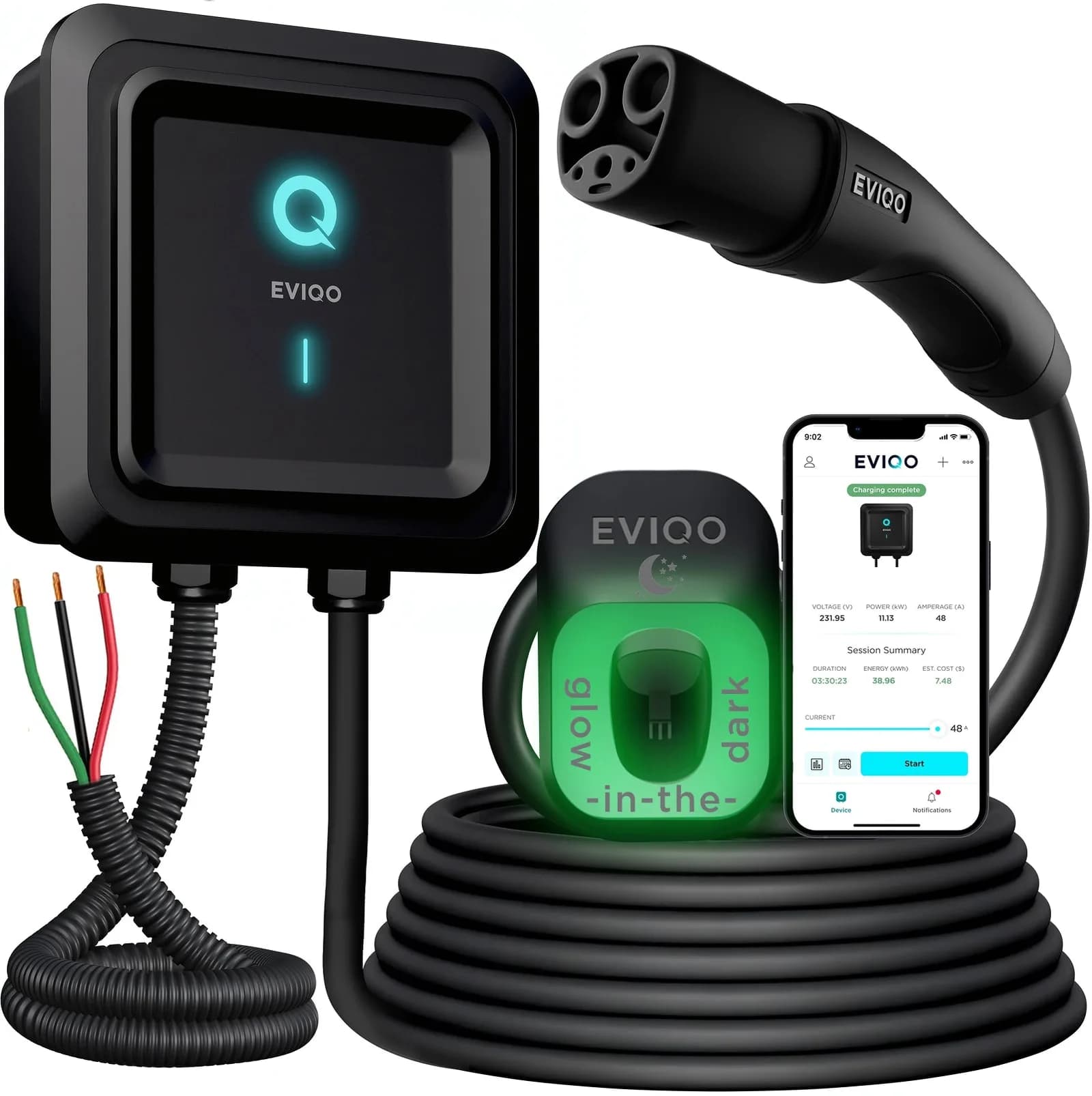
Eviqo J1772 Hardwired 48A
Wires direct to your panel for up to 48A of charging power, with Wi-Fi app control built in.
Charging Speed and Amperage
Amperage is the single biggest practical difference in the plug-in vs hardwired debate. A plug-in charger on a NEMA 14-50 outlet is capped at 40 amps (9.6 kW) because of the outlet's 50-amp circuit rating combined with the National Electrical Code's 125% continuous-load rule. A hardwired unit isn't limited by an outlet, so it can be wired for up to 48 amps (11.5 kW) on a suitably sized circuit.
In real-world terms, a 40A charger adds roughly 30–37 miles of range per hour, while a 48A charger can add up to 44 miles per hour on a compatible vehicle — about a 19% speed advantage for hardwired setups. Translated into charge time, a 48A hardwired charger typically brings most EVs from a low state of charge to 80–100% in 4–6 hours, versus 6–8 hours for a 40A plug-in charger, though the exact number depends on your vehicle's onboard charger and battery size.
For most daily drivers this gap matters less than it sounds — either option can replenish a typical commute's worth of range overnight. It becomes significant if you drive high daily mileage, share one charger across two EVs, or want the shortest possible top-up window.
How to Choose Between Plug-In and Hardwired for Your Situation
There's no universal winner in the plug-in vs hardwired EV charger decision — the right pick depends on your living situation, timeline, and how you use your car.
- Renters or frequent movers: A plug-in charger goes where you go. Unmount it, pack it, reinstall it at your next home, as long as a NEMA 14-50 outlet is available.
- Homeowners with an existing NEMA 14-50 outlet: If a range or dryer outlet is sitting unused in the garage, a plug-in charger gets you charging with minimal electrical work — often just mounting brackets and a compatibility check.
- Homeowners staying long-term who want maximum speed: A hardwired 48A charger is the better investment. It avoids outlet wear, tolerates outdoor weather better, and charges noticeably faster.
- Multi-EV households: The faster hardwired option helps offset the time cost of sharing one charger between two vehicles.
- Tight budgets with no existing outlet: Compare quotes for both — installing a new NEMA 14-50 outlet plus a plug-in charger can sometimes end up close to a hardwired install once electrician labor is factored in, so get an itemized quote before assuming plug-in is automatically cheaper.
Plug-In vs Hardwired EV Charger Comparison
Here's the side-by-side breakdown of the two formats, based on NEC code requirements and manufacturer specifications.
| Feature | Plug-In (NEMA 14-50) | Hardwired |
|---|---|---|
| Max amperage | 40A (9.6 kW) | 48A (11.5 kW) |
| Approx. charging speed | 30–37 mi/hr | Up to 44 mi/hr |
| Typical 80–100% charge time | 6–8 hours | 4–6 hours |
| Installation | Mount to existing outlet, or add one | Licensed electrician, direct to panel |
| Typical install labor | Lowest cost when a compatible outlet already exists | Higher, due to licensed-electrician labor and permits for a new dedicated circuit |
| Portability | Can move with you | Permanent, stays with the home |
| Durability in weather | More exposed connection wear over time | Sealed, no plug/unplug wear |
| Circuit requirement | Dedicated 50A breaker minimum | Dedicated 60A breaker for 48A models |
Installation, Code, and Safety Requirements
Both formats are governed by the same core electrical code. Under NEC Article 625, the circuit breaker must be sized at 125% of the charger's continuous rating — so a 40A charger needs at least a 50A breaker, and a 48A charger needs at least a 60A breaker. Each charging circuit must be dedicated, meaning no other outlets or appliances can share it, and all Level 2 charging circuits rated 50 amps or less must include Ground Fault Circuit Interrupter (GFCI) protection to guard against shock hazards.
For a hardwired install, a licensed electrician pulls a dedicated circuit from your panel, mounts the charger, and typically pulls a permit for inspection — this is not a DIY job. For a plug-in charger, if the NEMA 14-50 outlet doesn't already exist, an electrician still needs to install one on that same dedicated 50–60 amp circuit; only the final mounting step is simpler once the outlet is in place. One safety note worth planning for: plug-in chargers can experience nuisance tripping if both the charger's internal GFCI and a breaker-level GFCI sit on the same circuit — flag this to your electrician before installation.
Common Mistakes to Avoid
- Assuming any 50-amp outlet works. Confirm it's specifically a NEMA 14-50 — other 50A configurations aren't compatible with most Level 2 chargers.
- Skipping the permit and inspection. Both formats fall under NEC Article 625; an uninspected install can create insurance and resale issues later.
- Undersizing the breaker. Forgetting the 125% continuous-load rule is one of the most common code violations on EV charger installs.
- Not checking for double GFCI protection. Stacking the charger's built-in GFCI with a GFCI breaker on a plug-in setup is a frequent cause of nuisance tripping.
- Ignoring the panel's available capacity. A full electrical panel upgrade is sometimes needed before either format can be installed — get a load calculation first, not after.
Eviqo Offers Both — Pick the Setup That Fits You
Rather than forcing a choice of brand along with a choice of format, Eviqo (branded EVIPOWER) sells five Level 2 models spanning both plug-in and hardwired formats, in both J1772 (non-Tesla) and NACS (Tesla) connector types: J1772 Plug-In 40A, J1772 Plug-In 48A, J1772 Hardwired 48A, NACS Plug-In 40A, and NACS Hardwired 48A. For more detailed model-by-model comparison, check the Eviqo charger review, which breaks down all five models across installation type, connector, and cost. If you're also weighing portable charging gear beyond the home Level 2 setup, see our roundup of compact all-in-one charging solutions for on-the-go options. And for the foundational decision on when hardwired actually makes sense, our Level 2 charger buying guide walks through the pre-purchase checklist.
Eviqo Level 2 Charger Features
What We Like
- Same app and feature set whether you pick plug-in or hardwired
- IP66 weatherproofing on every model, not just premium tiers
- Both J1772 and Tesla NACS connectors available across formats
What to Consider
- Hardwired models still require a licensed electrician for installation
- 48A output requires panel capacity to support a 60A dedicated breaker
The Bottom Line
If you own your home and want the fastest, most durable setup, go hardwired — the extra install cost buys you higher amperage and a sealed connection. If you rent, move often, or already have a NEMA 14-50 outlet, a plug-in charger gets you on the road sooner for less labor. Eviqo covers both paths with the same app and warranty.
Explore Eviqo ChargersReferences
Recommended for you
 Level 2 EV Charger Guide: How to Pick the Best One (2026)
 EVIQO EV Charger Review 2026: Worth Buying? Full Guide
 ActionGlow Review 2026: Best Waterproof LED Lights? (IP68)
 LED Lights for Wakeboarding: 7 Night-Riding Safety Tips (2026)
 LED Lights for Snowboarding: 2026 Night Skiing Safety Guide
 RAWM Gaming Review 2026: Best 8K Wireless Mice Guide