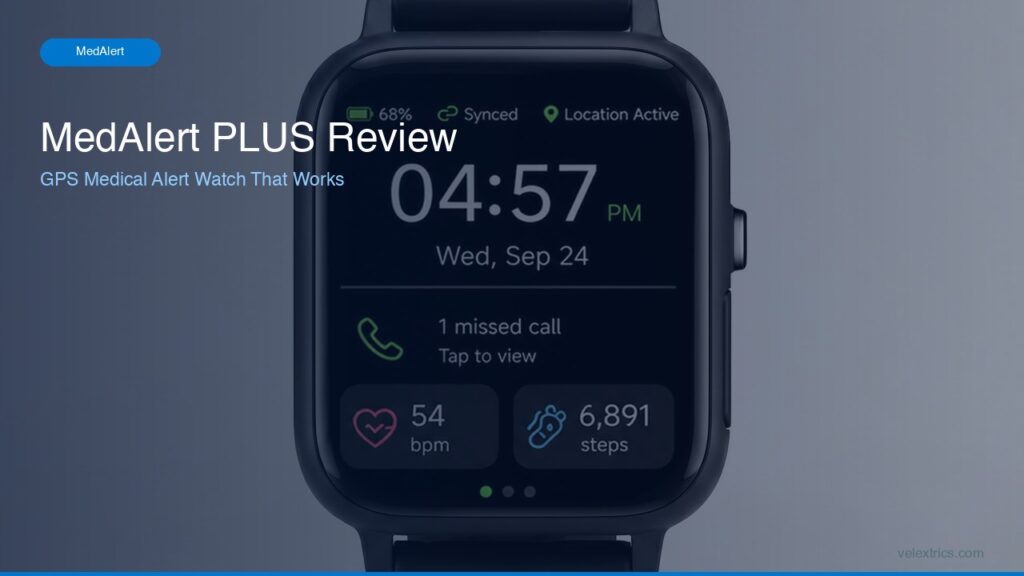
The MedAlert PLUS is an Australian-made medical alert watch designed specifically for the senior safety market: 4G GPS positioning, automatic fall detection, two-way SOS calling, and a waterproof build rated to 3-ATM. At $599 AUD, it sits at the premium end of the direct-to-consumer medical alert market and pairs with a 24/7 professional monitoring service.
This review examines what the PLUS delivers across the criteria that matter for senior safety devices – fall detection reliability, GPS accuracy, call quality, wearability, and how the monitoring plan structure compares to alternatives.
Disclosure: this article contains affiliate links. We may earn a commission if you buy through our links, at no extra cost to you.
MedAlert PLUS: Design and Key Features
Hardware Overview
The PLUS is offered across multiple form factors – watch, pendant, and brooch – allowing different wearing preferences within the same product line. This flexibility addresses a real-world challenge: some seniors who need a medical alert device are not watch wearers, and forcing a watch form factor reduces compliance.
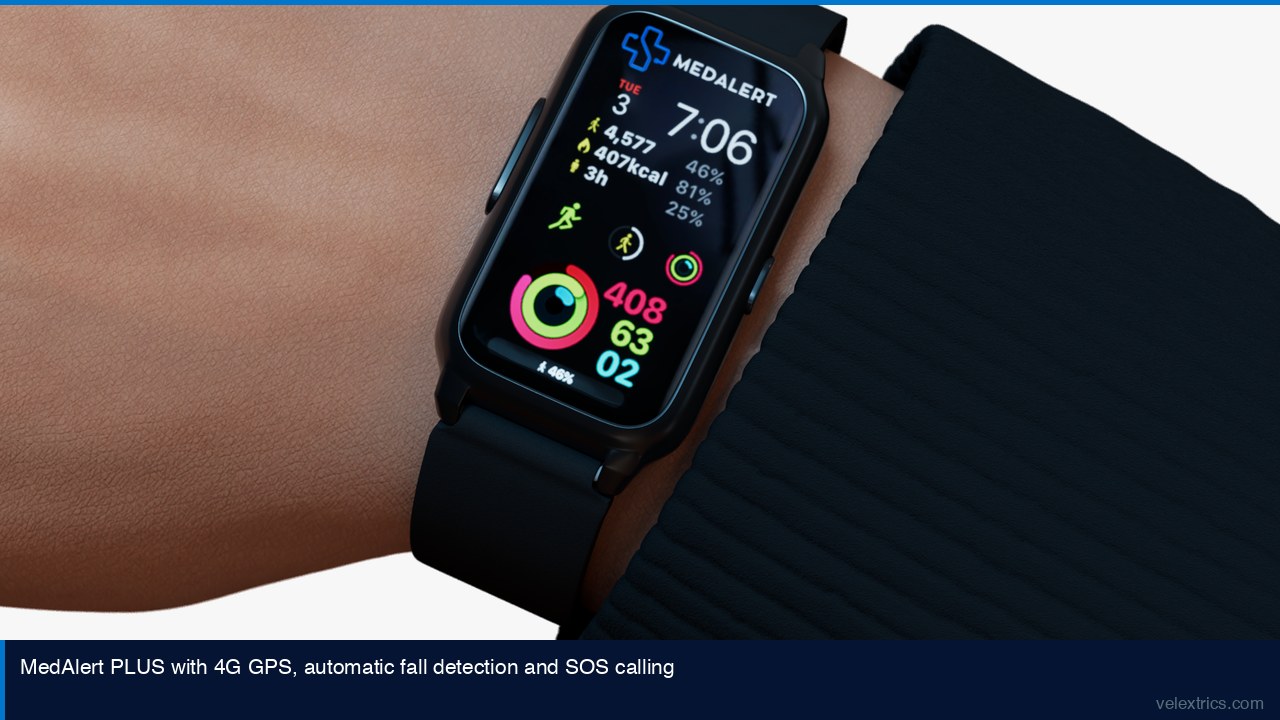
The watch version functions as a standard wrist device with the GPS antenna, cellular modem, accelerometer, gyroscope, and speaker/microphone integrated. The design is straightforward – a watch display with an accessible SOS button.
Connectivity is 4G, which provides better coverage and faster response initiation than 3G alternatives. MedAlert builds for Australian networks specifically, avoiding the band-compatibility issues that affect some imported devices.
Waterproof Rating
The 3-ATM (30-meter) rating means the PLUS can be worn through showers, while washing up, in rain, and during light swimming. This is the critical compliance feature for a medical alert device – the most common reason wearers remove medical alert devices is to shower, which is also one of the highest-risk environments for elderly falls.
A device that’s rated for water exposure can stay on continuously, which is the only usage pattern that provides full-time protection.
Battery Life
GPS and 4G connectivity are battery-intensive features. Like most GPS-enabled wearables, MedAlert recommends establishing a daily charging routine. The practical approach is nighttime charging on a bedside charger, similar to a smartphone – the watch is worn during waking hours and charged during sleep.
Fall Detection Performance
Automatic fall detection is the feature that justifies the price premium over simpler SOS buttons. The MedAlert PLUS uses accelerometer and gyroscope data to identify fall patterns – the rapid descent and impact signature that distinguishes a fall from normal movement.
The key performance question is sensitivity balance: too sensitive and the device triggers false alarms during vigorous activity (which causes wearers to ignore or disable it); too insensitive and it misses falls that need response.
MedAlert’s detection is tuned for typical senior activity patterns – slower movement ranges, normal daily activity, and the types of falls most common in this age group rather than athletic movement. This is the appropriate calibration for the target user.
When a fall is detected, the device initiates a warning sequence – typically a brief alert with an option to cancel if the trigger was a false alarm – before escalating to the emergency call. This prevents false alarms from dispatching emergency services unnecessarily while still providing rapid response to genuine falls.
SOS Calling and Two-Way Communication
The manual SOS button handles health events that don’t involve falling – chest tightness, sudden dizziness, confusion, or any situation where the wearer needs to initiate contact. The button is physically accessible and designed for reliable operation without precise motor control.
Two-way calling turns the watch into a speakerphone connected to either programmed family contacts or the 24/7 monitoring center. This allows:
– Emergency operators or family members to assess the situation before dispatching help
– The wearer to describe their location or condition if conscious and able
– Reassurance during the wait for assistance to arrive
The speaker and microphone are built into the watch body, which makes call quality somewhat dependent on positioning. The watch face facing upward during a call provides clearer audio than wrist positions that muffle the speaker.
GPS Positioning
Real-time GPS positioning is what distinguishes the PLUS from home-only medical alert systems. When an alert triggers, the device sends location coordinates to emergency contacts and, if using the monitoring plan, to the 24/7 response center.
Location accuracy uses GPS combined with cellular network triangulation and Wi-Fi positioning where available – the same multi-source approach used by smartphones. In urban environments with good network coverage, accuracy is typically sufficient for emergency response (within meters). In rural areas with reduced cellular coverage, accuracy may be lower.
For caregivers of seniors with dementia or cognitive decline, the GPS enables active location monitoring – checking where a family member is without calling – which is functionally different from the emergency-only use case and provides ongoing peace of mind.
The 24/7 Monitoring Plan
The optional 24/7 Emergency Response Call Centre Service ($345 AUD/year) is the component that transforms the PLUS from a GPS device into a complete monitored safety system.
What the monitoring plan provides:
– Trained emergency response operators available around the clock
– Operator assessment of alert situations before emergency dispatch
– Emergency services coordination when dispatch is appropriate
– Fallback when programmed family contacts don’t answer
The bundle pricing ($844 AUD for device + one year monitoring) makes the combined cost of hardware plus monitoring explicit. For seniors living alone without nearby family, the monitoring plan is the element that closes the gap between a device that alerts and a system that responds.
Family contact-only operation (without the monitoring plan) is appropriate when reliable family members are consistently reachable and aware of the device’s alert calls. The monitoring plan is the right choice when that reliability isn’t certain – including overnight hours, work hours, or periods when family contacts travel.
MedAlert PLUS vs. Competitors
| Product | Price | Monitoring | GPS | Fall Detection | Water |
|---|---|---|---|---|---|
| MedAlert PLUS | $599 AUD | Optional $345/yr | 4G GPS | Automatic | 3-ATM |
| MedAlert Standard | $499 AUD | Optional $345/yr | 4G GPS | Automatic | Check specs |
| Generic import watches | $100-250 AUD | None or limited | Variable | Variable | Variable |
The primary competitive gap is Australian market fit. Many lower-cost alternatives are imported devices designed for different cellular band standards, with monitoring plans that don’t include Australian emergency services coordination. MedAlert’s Australian-specific build means 4G coverage on Australian networks and monitoring that dispatches Australian emergency services.
MedAlert PLUS Product Line
PLUS Watch ($599 AUD): Primary form factor. Watch display, 4G GPS, fall detection, SOS calling. Recommended for those comfortable wearing a watch daily.
PLUS Pendant: Same core functionality in pendant form factor. For users who don’t wear watches but need equivalent protection.
PLUS Brooch: Discreet clip-on format. Some users prefer this for attaching to clothing rather than wearing on the wrist or around the neck.
Standard Watch ($499 AUD): Core GPS and fall detection at lower price point. Same fundamental protection without multi-form-factor flexibility.
→ Shop All MedAlert Products – Free Australian Delivery
Verdict
The MedAlert PLUS delivers the core function of a GPS medical alert watch reliably: real-time location, automatic fall detection, and two-way SOS calling in a waterproof device built for Australian networks.
At $599 AUD for the device and $345 AUD/year for professional monitoring, the total cost of protection is comparable to or less than traditional monitored home alert systems – with the significant advantage of GPS coverage anywhere rather than a home-only perimeter.
For seniors living independently who want a device that works both inside and outside the home, or family members selecting a safety device for an elderly parent, the PLUS provides the technology that the situation actually requires.
Frequently Asked Questions
Is MedAlert an Australian company?
Yes. MedAlert is Australian-owned and their devices are designed for Australian 4G networks. Support and monitoring services operate locally.
What happens if the battery dies during the day?
The device will cease to function, including fall detection and GPS. Establishing a consistent charging routine (nightly charging) is the standard recommendation to prevent this.
Can the MedAlert PLUS be shared between two people?
No. The device is registered to a single user with specific emergency contacts and, if applicable, monitoring plan enrollment. A second device is needed for a second user.
Does MedAlert work in rural areas?
GPS and 4G functionality depend on cellular network coverage. In areas with limited 4G coverage, GPS location accuracy may be reduced and cellular calls may experience degraded quality. Check network coverage maps for the specific area.
What is the warranty?
MedAlert offers a standard warranty with an option to extend to 3 years total (+2 years at $49.90 AUD).
Is setup difficult?
Setup involves registering the device, programming emergency contacts, and (if selected) activating the monitoring plan. MedAlert provides setup support for customers who need assistance.