INNOVV Motorcycle Dash Cams 2026: K5, K6 & K7 Systems Compared
The INNOVV K5, K6 and K7 motorcycle dash cams differ in resolution, GPS sampling rate and parking-mode support. This guide compares specs side-by-side and maps each system to touring, commuting or track riding, plus the RC6 BikeGuard radar unit.
How INNOVV Motorcycle Dash Cam Systems Work
- How INNOVV Motorcycle Dash Cam Systems Work
- INNOVV K5 vs K6 vs K7: Resolution, GPS & Parking Mode Compared
- How to Choose the Right INNOVV System for Your Riding
- RC6 BikeGuard: Adding Radar Blind-Spot Detection
- Installation Standards: Power, Grounding & Mounting
- Common Installation Mistakes & Fixes
- Where INNOVV Fits Your Setup
An INNOVV motorcycle dash cam pairs synchronized front-and-rear cameras with GPS, parking-mode standby and an IP67 waterproof aluminum housing built for open-air riding — but the right pick depends on resolution, storage and whether you actually need parking mode. This guide compares the INNOVV K5, K6 and K7 systems, plus the RC6 BikeGuard radar unit, spec-by-spec so you can match a setup to touring, commuting or track riding.
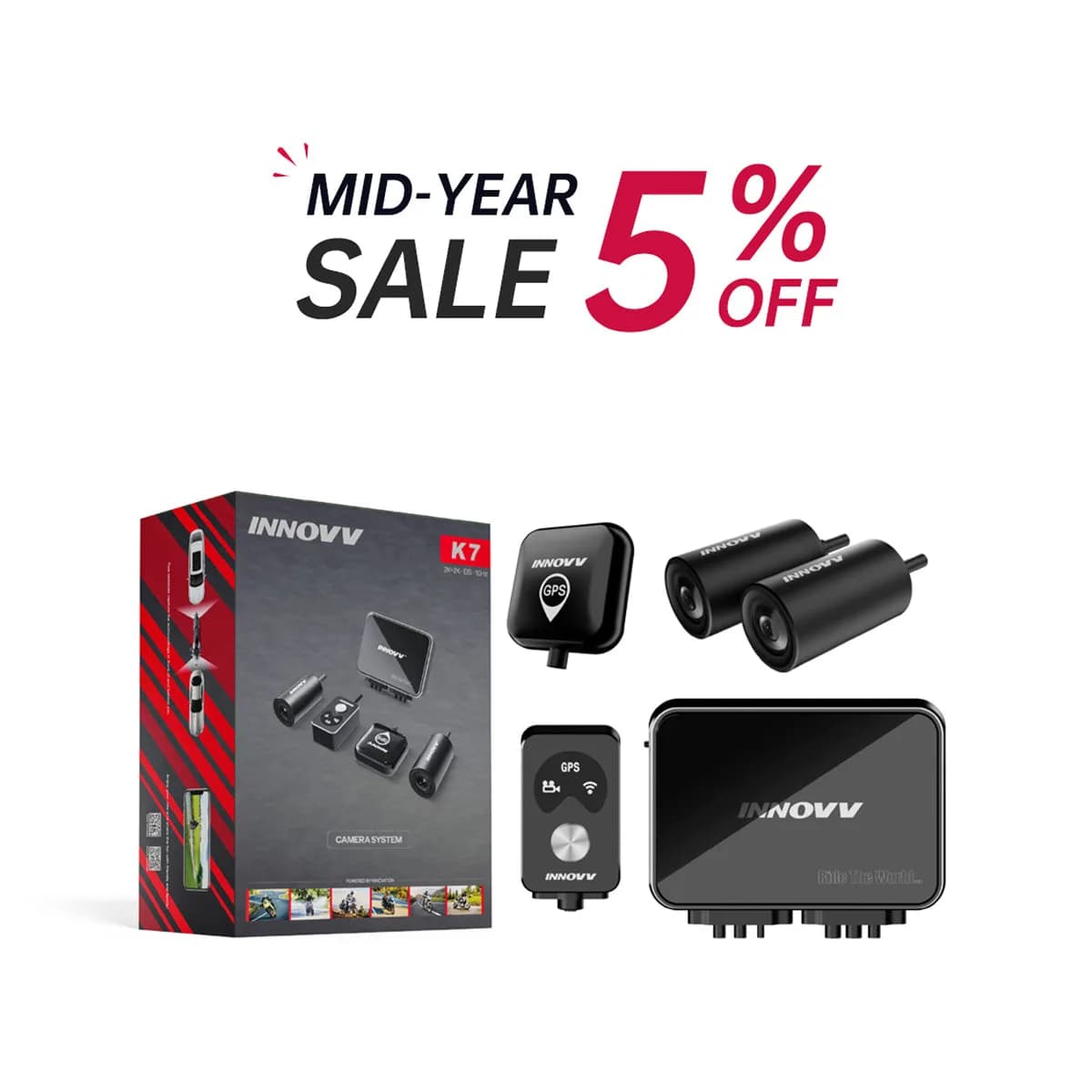
The K7 is the most balanced INNOVV motorcycle dash cam — symmetric dual-2K front/rear recording with 10Hz GPS and parking mode
If you only need one recommendation: the K7 gives you 2560×1440P on both front and rear channels, so neither view is the weak link in an incident review. Riders who want maximum front-camera detail should look at the K5 instead; budget-focused commuters can drop to the K6.
Check INNOVV K7 DetailsKey Highlights
- K7 records symmetric dual-2K (2560×1440P) front and rear at 30fps with Sony STARVIS IMX335 sensors on both channels.
- K5 tops out at 4K Ultra HD (3840×2160P) front / 1080P rear using an 8-megapixel Sony STARVIS IMX415 sensor.
- K6 is the entry system: 2K front / 1080P rear, no GPS, no parking mode.
- RC6 BikeGuard adds 77–79GHz radar that tracks up to 64 objects for blind-spot detection.
- Every model ships with a 2-year warranty and a 30-day money-back guarantee.
How INNOVV Motorcycle Dash Cam Systems Work
Every INNOVV motorcycle dash cam records two synchronized video channels — one facing forward, one facing back — onto a single microSD card, so an incident is captured from both directions at once. The systems differ mainly in sensor resolution, GPS sampling rate, and whether a G-sensor-triggered parking mode is included.
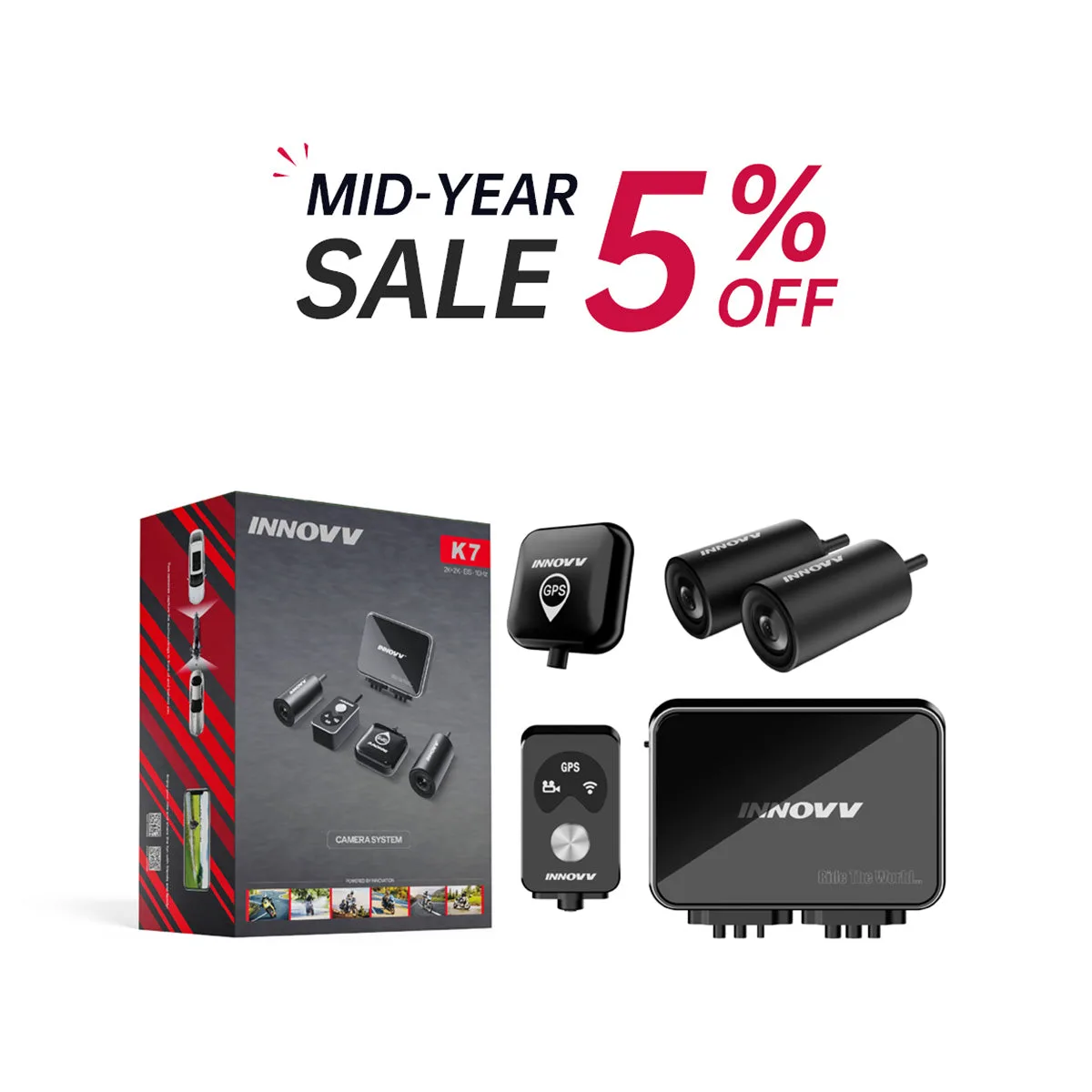
All three core systems use an aerospace-grade aluminum housing rated IP67 for dust and water resistance, with a 120° field of view on each lens. Wi-Fi (2.4GHz, with 5.8GHz added on K7 and K5) lets the companion app pull live view and download clips without removing the SD card. GPS modules on K7 and K5 keep working even when mounted completely hidden behind fairing plastic, which is why installers can tuck the DVR module under the seat without sacrificing location tracking.
Parking mode — available only on the K7 and K5 — uses the motorcycle's G-sensor to detect motion or vibration while parked and begin recording automatically, provided the camera's main power is wired directly to the battery with a separate ignition-switched trigger wire. The K6 and RC6 do not include this feature.
INNOVV K7 Dual-2K System
10Hz GPS plus matched 2560×1440P front/rear video — no weak channel in an incident review.
INNOVV K5 vs K6 vs K7: Resolution, GPS & Parking Mode Compared
INNOVV groups its three core dash cams by resolution tier: the K6 is entry-level, the K7 is the mid-range symmetric-2K system, and the K5 is the premium 4K-front option. Storage, GPS sampling rate and parking-mode support all scale with the tier, so picking a model is really about deciding how much front-camera detail and touring data you need.
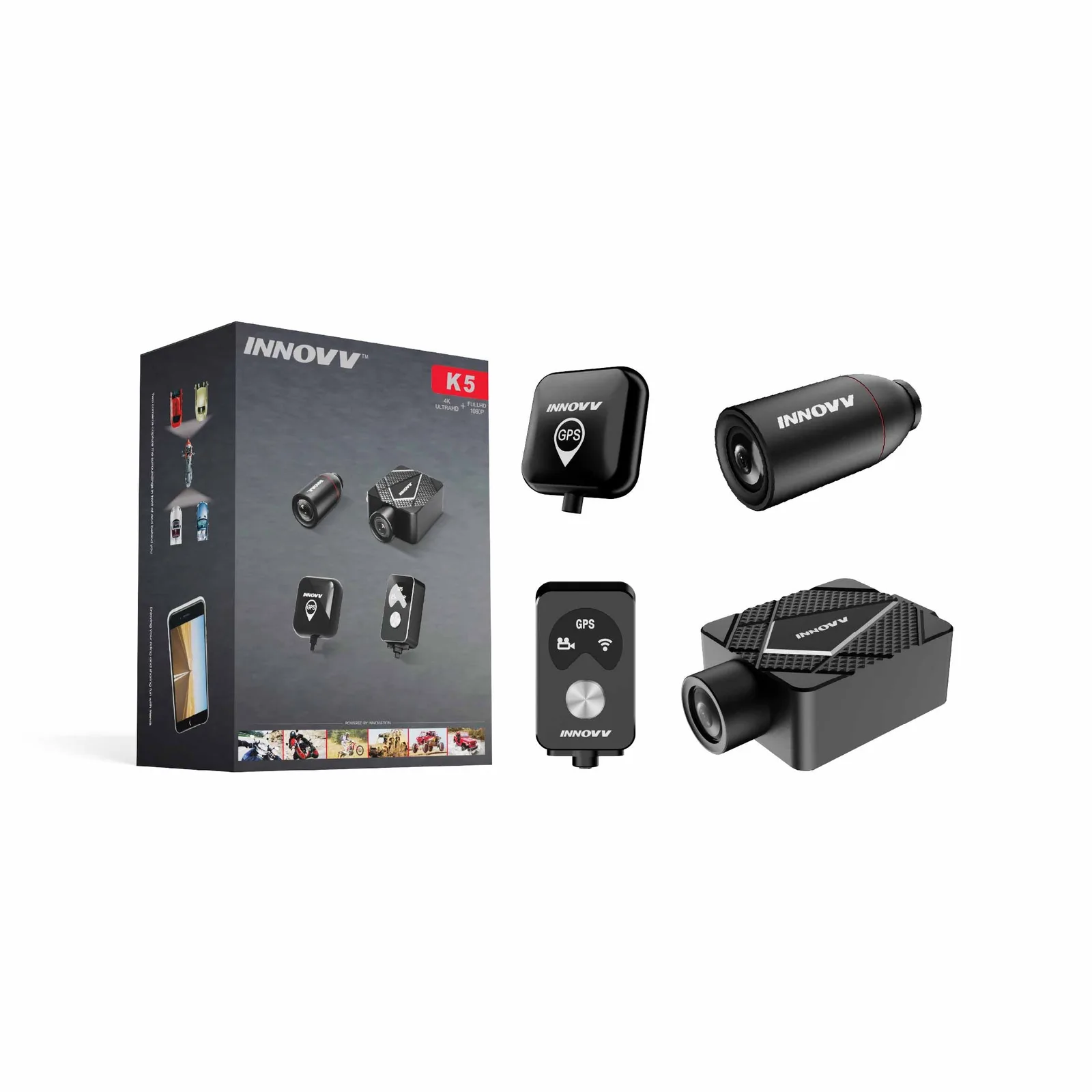
INNOVV K5 (4K + 1080P)
What We Like
- Highest front-camera resolution in the lineup, useful for plate/detail capture
- Automatic parking mode on motion or vibration detection
What to Consider
- Rear channel stays at 1080P, and the manufacturer lists it as limited availability
The K5 trades a matched rear view for the sharpest possible front recording, which matters most for riders documenting plates or road surface detail rather than symmetric coverage.
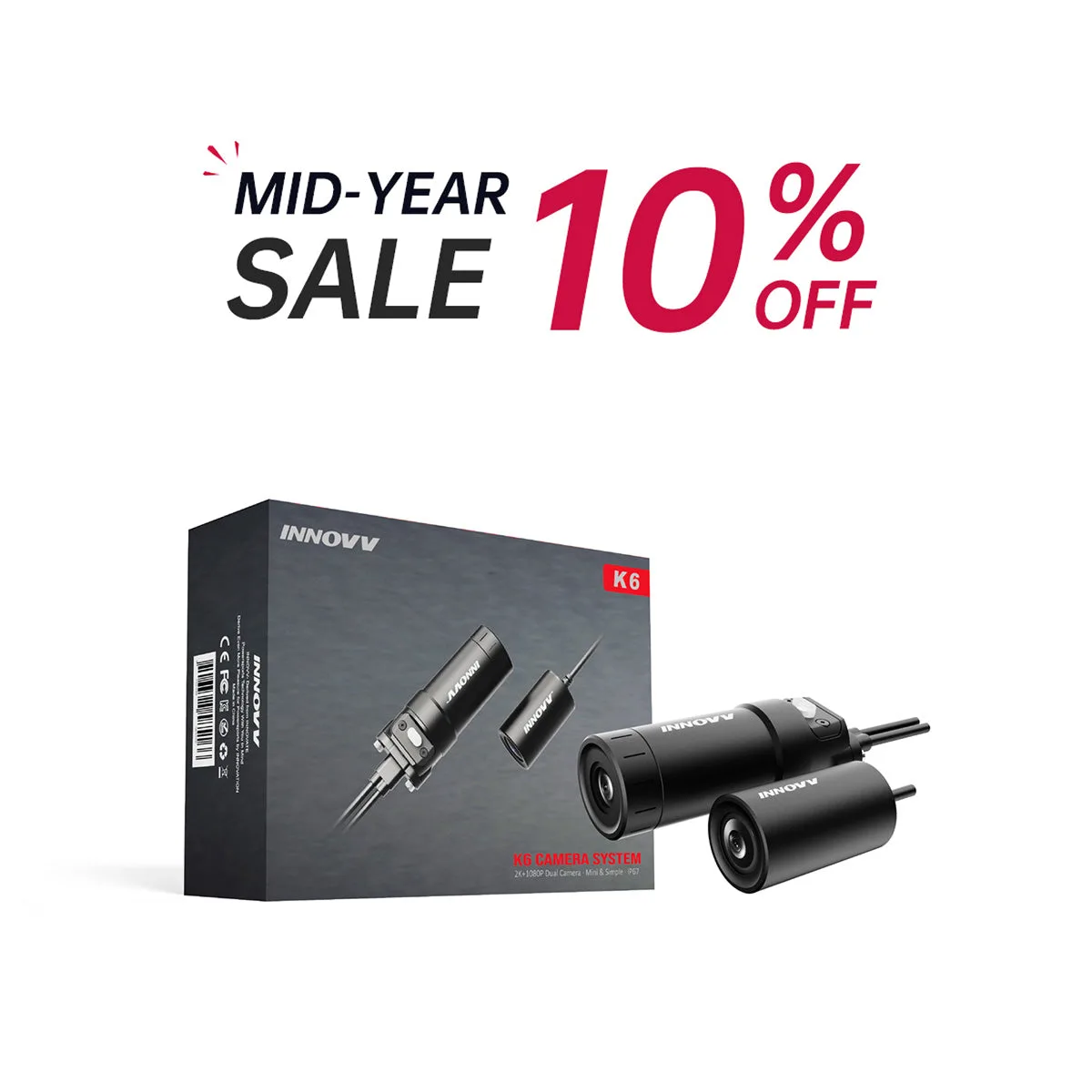
INNOVV K6 (2K + 1080P)
What We Like
- Same front sensor family as the K7, at a simpler entry-level spec
- IP67 rated with 0.5m submersion resistance for 30 minutes
What to Consider
- No GPS or parking mode, so it can't log routes or watch the bike unattended
The K6 is the system to pick when GPS route logging and parking-mode standby aren't priorities and you mainly want reliable, waterproof front/rear footage for daily rides.
INNOVV K7 (Dual-2K)
What We Like
- 10Hz GPS is the fastest sampling rate in the lineup, useful for touring route data
- No weak camera channel — front and rear record at the same 2K resolution
What to Consider
- Doesn't match the K5's 4K front-camera detail
For most touring and commuting riders, the K7's balance of matched resolution, fast GPS, and parking mode makes it the easiest system to justify.
| Model | Front / Rear Resolution | GPS | Parking Mode | Max microSD |
|---|---|---|---|---|
| K6 | 2K / 1080P | None | No | 256GB |
| K7 | 2K / 2K | 10Hz | Yes | 512GB |
| K5 | 4K / 1080P | 5Hz | Yes | 512GB |
| RC6 | 2K / 1080P + radar | None | No | 256GB |
How to Choose the Right INNOVV System for Your Riding
Match the model to how and where you actually ride rather than chasing the highest spec sheet. The three core systems and the RC6 radar unit are built for different priorities — resolution, route data, or collision-avoidance awareness.
Touring and long-distance riding
Riders who log long routes benefit most from the K7's 10Hz GPS, which samples position twice as often as the K5's 5Hz module and exports GPX tracks through the companion app for post-ride mapping. Combined with matched 2K front/rear resolution, the K7 avoids the weak-rear-camera trade-off that touring riders would otherwise accept on the K5.
Daily commuting
If the dash cam's job is simply documenting daily traffic incidents, the K6's 2K front / 1080P rear pairing and IP67 housing cover the basics without paying for GPS or parking-mode hardware you may not use every day.
Track days and detail-critical footage
Track riders prioritizing maximum image detail — reading track markers, verifying line choice, or documenting close-quarters incidents — get the most value from the K5's 4K front sensor, accepting a 1080P rear channel and the model's currently limited availability in exchange.
RC6 BikeGuard: Adding Radar Blind-Spot Detection
The RC6 pairs a 2K front / 1080P rear dash cam with a 77–79GHz millimeter-wave radar system that tracks up to 64 objects simultaneously across a 150° horizontal field and 0–50 meter range, surfacing blind-spot alerts within about 3 seconds. It doesn't include GPS or parking mode — its focus is real-time collision-avoidance awareness rather than route logging or after-hours monitoring.
Riders who already run a K6 or K7 for recording and want an additional layer of lane-change safety can treat the RC6 as a complementary add-on rather than a replacement dash cam.
Installation Standards: Power, Grounding & Mounting
INNOVV's own installation guidance covers three technical standards that determine whether a system runs reliably on a motorcycle's electrical system, not just how the cameras are mounted.
- Use switched power, not a direct battery tap. A properly wired trigger reads 0V with the ignition off and about 12V with it on; a direct battery connection instead drains the bike's battery over a few days of continuous draw.
- Ground to bare metal or the battery negative terminal. Powder-coated frames insulate a bolted ground wire; sanding to bare metal — or grounding directly to the battery — keeps resistance close to zero Ohms and prevents unstable video, Wi-Fi, or GPS issues.
- Avoid cutting the original wiring harness. Motorcycle vibration loosens unsecured splices over time; pre-wired auxiliary plugs or dedicated fused distribution blocks hold up better, and bench-testing connections before final install catches problems early.
- Choose a mounting method that fits the bike. 3M adhesive pads work for tight fairing spaces without permanent modification, while the included L-bracket suits bikes with more standard mounting points; GPS modules still function when tucked completely under plastic fairing.
- Wire parking mode correctly on K7/K5. Main power must run to the 12V battery directly, with the yellow trigger wire on a separate ignition-switched ACC source — an aftermarket power module that cuts all power at ignition-off will disable parking mode entirely.
Common Installation Mistakes & Fixes
- Mistake: wiring straight to the battery. Fix: route main power through a switched/ACC source so the camera fully powers down at ignition-off.
- Mistake: bolting a ground wire to painted frame. Fix: sand to bare metal or run the ground straight to the battery negative terminal.
- Mistake: splicing into the factory harness. Fix: use auxiliary plugs or a fused distribution block, and secure all runs with zip ties away from the exhaust.
- Mistake: expecting parking mode on a K6 or RC6. Fix: only the K7 and K5 support automatic parking-mode recording.
Where INNOVV Fits Your Setup
INNOVV builds all four systems around the same core standards — IP67 sealing, Sony STARVIS sensors, and a 2-year warranty — so the decision mostly comes down to resolution symmetry, GPS needs, and whether radar-based blind-spot detection matters for your riding. For more on how the brand's engineering approach compares across its motorcycle electronics lineup, see our deeper look at INNOVV's technology and design.
The Bottom Line
For most riders, the INNOVV K7 is the best-balanced motorcycle dash cam: matched dual-2K recording, 10Hz GPS, and parking mode without the K5's rear-camera trade-off. Choose the K5 if front-camera detail matters most, the K6 for a simpler commuting setup, or add the RC6 for radar blind-spot alerts.
See INNOVV SystemsReferences
- INNOVV. K7 Dual-2K Dashcam specifications. INNOVV Official (2026).
- INNOVV. K5 4K+1080P Dashcam specifications. INNOVV Official (2026).
- INNOVV. RC6 BikeGuard dashcam + radar system. INNOVV Official (2026).
- INNOVV. Motorcycle dash cam installation: 3 key technical standards. INNOVV Installation Guide (2026).
- INNOVV. Official dashcam catalog and warranty terms. INNOVV Official (2026).
Recommended for you
 How to Protect Your Camera Lens in the Field: A Wildlife Photographer’s 2026 Guide
 LensCoat Review 2026: The Best Camo Lens Protection for Serious Photographers
 Best Camera Lens Covers for Wildlife Photography in 2026: The Complete Field Guide
- Retropia Review: 5 Best Retro Camera Accessories for Modern Creators
 Waterproof Stage Lights: Why IP65 Ratings Matter for Outdoor Shows
 From Trails to Timelines: Capture Every Moment with Altitude