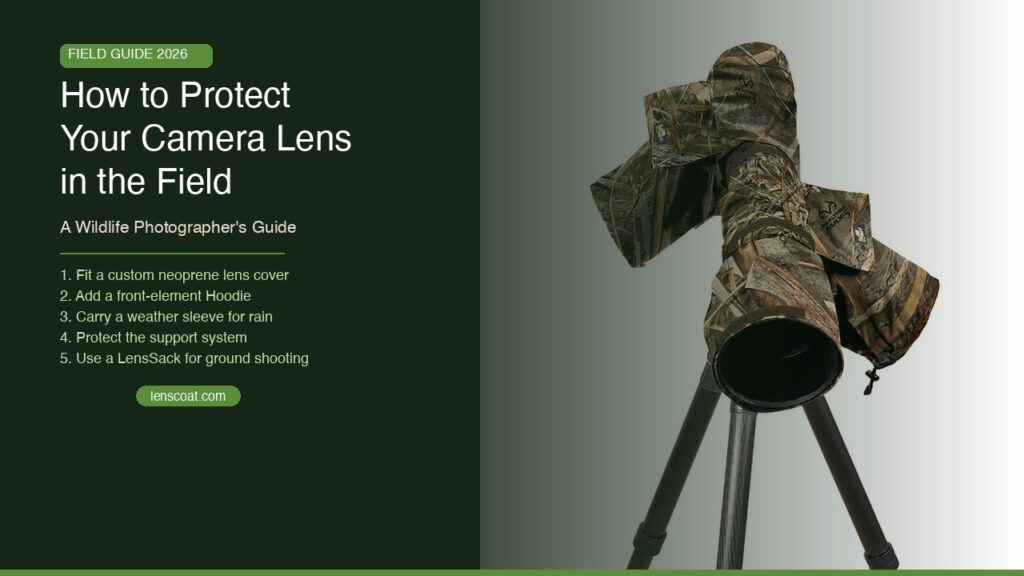
Knowing how to protect your camera lens in the field is not the same as knowing how to protect it in a bag or on a shelf. Field conditions are dynamic: the weather changes mid-session, the terrain you’re covering changes the physical risks, and – in wildlife photography specifically – your ability to approach subjects depends partly on how much your gear stands out.
This guide covers the practical steps for protecting your camera lens in the field in 2026, organized by threat type and calibrated for outdoor photographers working with telephoto and super-telephoto lenses. It draws on what serious wildlife photographers actually carry and what the gear is designed to do.
Disclosure: this article contains affiliate links. We may earn a commission if you buy through them, at no extra cost to you.
Why Field Lens Protection Is Different
A lens in a camera bag is protected by the bag. A lens on a tripod at the edge of a Scottish loch at dawn, with a squall moving in from the northwest, is your problem.
Field photography with telephoto lenses introduces specific risks that bag and case protection doesn’t address:
Rain and moisture: Telephoto lenses have large front elements and long barrels that expose significant surface area to precipitation. Even weather-sealed lenses have limits – and weather sealing protects the optical and electronic internals, not the barrel finish, coatings, or focus ring.
Dust and grit: Dry environments – desert, savanna, high alpine – generate particulate matter that finds its way into every gap. Grit in a manual focus ring causes wear. Dust on the front element scatters light and reduces contrast.
Thermal stress: Moving a cold lens into a warm blind, or a warm lens into cold morning air, causes rapid temperature change in the barrel and glass. Rapid thermal cycling stresses optical cement in element groups over time.
Impact and abrasion: Lenses in use contact things. A telephoto laid on a window sill for vehicle-based shooting picks up metal abrasion. A lens resting on rocky ground while you reposition the tripod picks up stone dust and micro-scratches on the barrel.
Wildlife visibility: This one matters specifically for wildlife photography: a bare white or silver telephoto barrel reflects light. A camo-covered lens reduces the approach distance lost to visual detection.
Understanding which risks apply to your shooting environment tells you what protection you actually need.
The 5-Step Field Protection Checklist
Step 1: Fit a Custom Neoprene Lens Cover
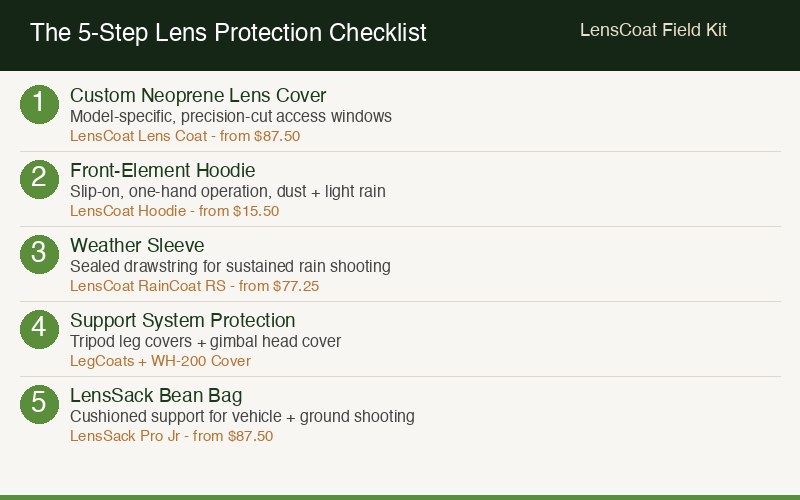
A model-specific neoprene lens cover is the single most effective step in how to protect your camera lens in the field for daily outdoor shooting. It addresses rain resistance, thermal buffering, physical impact absorption, and visual signature reduction in one install.
LensCoat makes precision-fit neoprene covers for Canon, Nikon, Sony, Sigma, and Fuji telephoto lenses – each with access windows positioned at the correct locations for the manual focus ring, AF switches, and tripod collar on your specific model. Covers start from around $87.50 for 300mm-class lenses and run to $140+ for 600mm super-telephoto primes.
Critical detail: the access windows on a custom-fit cover need to match your lens, not approximate it. A cover with generic slots requires you to peel back neoprene every time you adjust focus or switch between AF and MF mid-shoot. That defeats the purpose.
Step 2: Add a Front-Element Hoodie
The front element is the most exposed glass on a telephoto lens. A neoprene Hoodie – a slip-on front cap sized to the front diameter of your lens barrel – protects the front element from dust, light rain, and contact with vegetation when you’re moving through terrain.
At $15.50-$27.75 depending on size, LensCoat Hoodies are the lowest-cost addition to a field protection setup. They install and remove in one hand, which matters when you have 30 seconds to get the shot.
The Hoodie is not a substitute for a full lens coat – but as an addition to one, it provides front-element protection the barrel cover alone doesn’t address.
Step 3: Carry a Weather Sleeve for Rain Days
When you know you’re heading into sustained rain – coastal shoots, mountain weather, tropical field work – a dedicated weather sleeve goes over the lens coat as an additional layer. LensCoat’s RainCoat RS Large ($77.25-$82.50) is designed to be pulled on mid-session without removing the lens from the tripod.
The key difference between a weather sleeve and a standard lens coat is the sealed body end: a raincoat has a drawstring or elastic seal at the camera-body junction that prevents water from running down the barrel and pooling at the mount. This is the protection gap that standard neoprene covers don’t fully address.
For heavy weather shooting: the LensCoat RainCoat 2 Pro ($137+) adds heavier sealing and extended coverage for sustained rain. If you shoot regularly in coastal rain or high-elevation storm conditions, this is the version to carry.
Step 4: Protect the Support System
Knowing how to protect your camera lens in the field extends beyond the lens itself. The tripod legs and gimbal head are in contact with mud, water, and rough surfaces every session. Cold metal tripod legs conduct cold to your hands and lose their anodizing over time from wet ground contact.
LensCoat makes LegCoats (neoprene leg covers for tripod sections), LegWraps (quick-attach foam wraps), and covers for the Wimberley WH-200 and similar gimbal heads ($39.25). Matching these to the lens cover in camo pattern creates a complete, color-coordinated field setup – relevant if you’re shooting from a blind where visual cohesion matters.
Step 5: Use a LensSack for Ground-Level and Vehicle Shooting
A LensSack bean bag ($33+) protects the lens from direct contact with hard or abrasive surfaces when you’re shooting from a vehicle window, fence post, or low ground position. The bag cushions the tripod collar and barrel from the metal of a car door sill or the grit of a rock ledge.
At ground level – standard for many bird photographers working from a prone or low crouch position – the LensSack Pro Jr doubles as a support platform and a buffer between the lens and whatever surface you’re working from.
Field Protection by Environment
Different field environments prioritize different protection strategies:
Wetlands and Coastal Environments
Rain is the primary risk. Lead with a lens coat, add a Hoodie, carry a RainCoat. Sea air accelerates corrosion on metal components – a neoprene cover slows this on the barrel. The Realtree Max5 camo pattern is specifically designed for wetland vegetation (sedge, cattail, reed) and is the standard choice for waterfowl and shorebird photography.
Woodland and Scrub
Dust and physical contact with vegetation are the main threats. A lens coat absorbs the contact damage from branches and brush. Realtree Edge or solid Forest Green works better than Max5 in higher-contrast woodland light. Focus on Hoodie use when moving through dense cover.
Desert and Dry Grassland
Dust is the primary risk. A well-sealed neoprene cover keeps grit out of the focus ring. Carry a blower and microfiber cloth for the front element – even through a Hoodie, some fine dust infiltrates during extended shooting. Thermal stress is also higher in desert environments (cold night air to intense midday sun) – a neoprene cover slows thermal cycling on the barrel.
Vehicle-Based Safari / Window Shooting
LensSack bean bag support plus a full lens coat is the standard setup. The LensSack cushions the tripod collar on the window sill; the lens coat absorbs the vibration and dust from vehicle movement. A RainCoat is worth carrying for African storm season.
What Not to Do
Don’t remove the cover to check the lens in the field. Paranoid partial unwrapping to “make sure the cover is on right” is how you introduce dust to a clean front element. Install it correctly before you go out, then leave it.
Don’t use a lens cover as a carrying bag. Lens coats are for field use, not transport. For transit, use a dedicated lens pouch – LensCoat makes these too (LensTote, lens pouches) – where the cushioning is full 360-degree wraparound, not a field-access sleeve.
Don’t skip the weather sleeve because “the lens is weather-sealed.” Optical weather sealing protects internal elements and electronics. It does not protect the barrel finish, the focus ring, or the front element coating from sustained water exposure. A barrel that looks fine after a wet session may be hiding micro-corrosion in the focus ring tracks.
The Gear Summary
To fully implement how to protect your camera lens in the field, here is what a complete LensCoat setup looks like for a wildlife photographer working with a 500mm telephoto:
| Item | Product | Price |
|---|---|---|
| Barrel cover | LensCoat Neoprene (500mm class) | $98.75+ |
| Front element | LensCoat Hoodie (appropriately sized) | $15.50-$20.50 |
| Rain protection | LensCoat RainCoat RS Large | $77.25-$82.50 |
| Ground support | LensCoat LensSack Pro Jr | $87.50+ |
| Gimbal protection | LensCoat WH-200 cover | $39.25 |
Total for a complete field setup: around $318-$328. For a lens that costs $10,000 or more, this is around 3% of replacement cost.
→ Build your LensCoat field kit at LensCoat.com
Frequently Asked Questions – How to Protect Your Camera Lens in the Field
What is the most important thing to protect a camera lens in the field?
A custom-fit neoprene lens cover is the single most effective protection step for outdoor photography. It addresses rain, impact, dust, and thermal stress simultaneously while providing camouflage in wildlife contexts.
How do I protect my lens from rain in the field?
Use a dedicated weather sleeve (RainCoat) over your existing lens coat. A standard neoprene cover is water-resistant; a RainCoat is designed for sustained shooting in active rain with a sealed seal at the camera body end.
How do wildlife photographers hide their lenses from animals?
Camo neoprene lens covers (Realtree Max5 for wetlands, Realtree Edge for woodland) reduce the visual signature of a large telephoto barrel. Full concealment uses a LensHide photo blind system to hide the photographer and the entire rig.
Does a neoprene cover affect autofocus or image quality?
No. The neoprene covers the barrel only – it does not touch the front element, and the access windows allow normal use of AF switches, MF rings, and stabilization controls without removing the cover.
How do I prevent fogging on my lens in cold weather?
A neoprene lens cover slows the thermal transfer between the cold ambient air and the barrel, reducing the rate of temperature change and the associated risk of condensation. For extreme cold-to-warm transitions (entering a warm vehicle from a cold field), allow the lens to acclimatize inside the cover rather than removing it immediately.
Can I use LensCoat products with a gimbal head?
Yes. LensCoat makes specific covers for popular gimbal heads (Wimberley WH-200 and similar) and their LensSack bean bags are designed to support lenses on gimbal mounts as well as fixed positions.
See also: Best Camera Lens Covers for Wildlife Photography 2026 – LensCoat Review 2026