Most people buy earplugs twice in their concert-going life: once when they forget to bring any and grab foam from the venue, and once when they decide they want something better. Knowing how to choose earplugs for concerts before the second purchase saves you from buying something that almost works – a product with the right specs but the wrong fit, or the right fit but inadequate attenuation for the venues you attend.
This guide covers every factor that matters: attenuation level, filter type, fit, material, and the specific situations where each choice changes the outcome.
Disclosure: this article contains affiliate links. We may earn a commission if you buy through our links, at no extra cost to you.
Why Concert Earplugs Are Different from Standard Earplugs
The distinction matters before anything else. Standard earplugs – foam, industrial, travel – prioritize maximum attenuation. They’re designed to reduce sound as much as possible, which is appropriate for loud machinery, sleeping environments, or situations where the source of noise is unwanted.
Concert earplugs prioritize attenuation with preserved sound quality. The goal is not silence but a quieter version of the music that retains tonal balance, dynamics, and clarity. An earplug that reduces a 100dB concert to 60dB has done its job from a protection standpoint, but if it removes all the high frequencies in the process, the music is no longer worth listening to.
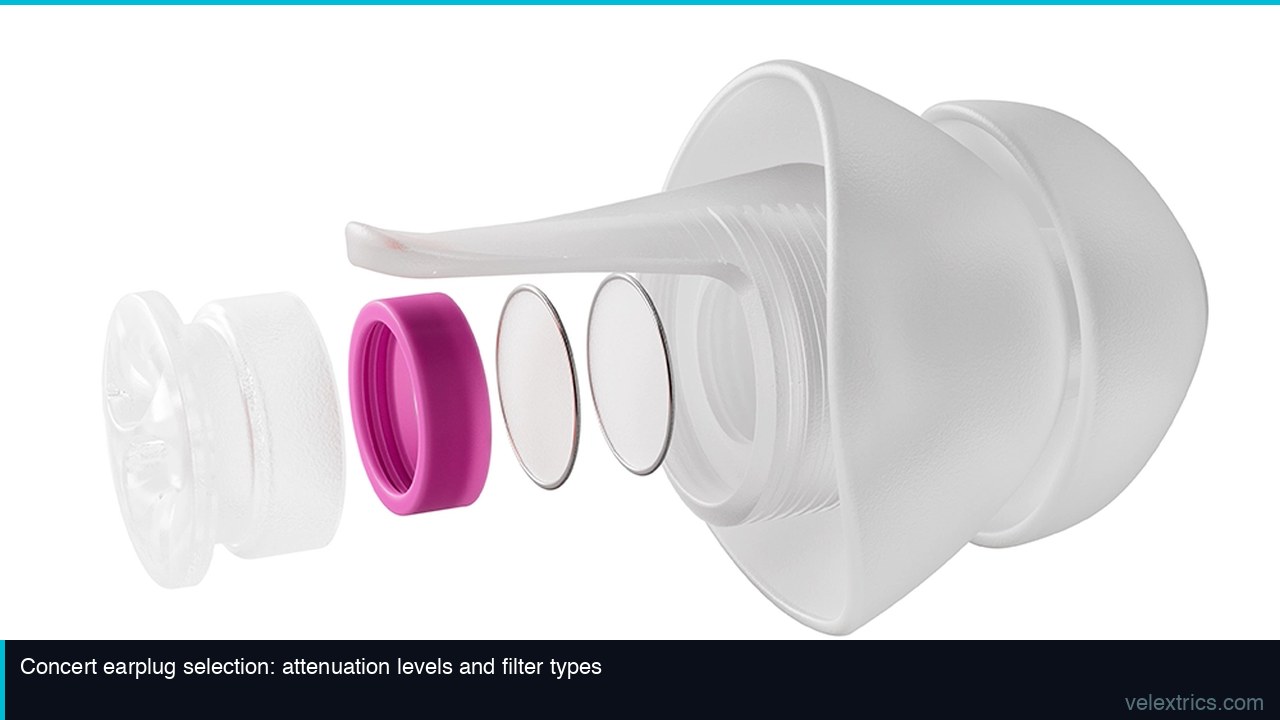
High-fidelity concert earplugs use engineered acoustic filters to achieve even attenuation across the frequency spectrum. This is the single most important differentiator when choosing earplugs for concerts.
How to Choose Earplugs for Concerts: Key Factors
Factor 1: How Loud Are the Concerts You Attend?
Volume determines the attenuation level you need. Concert SPL levels vary significantly:
- Acoustic/jazz venues: 75-85dB – light attenuation (10-15dB) is sufficient
- Rock clubs and mid-size venues: 90-100dB – 18-22dB attenuation recommended
- Arena concerts and festivals: 100-110dB – 22-26dB attenuation recommended
- Very loud clubs, DJ events: 105-115dB – 24-27dB attenuation recommended
At 100dB, hearing damage begins within 15 minutes of unprotected exposure. At 110dB, damage occurs within 2 minutes. Matching your attenuation level to your typical concert environment is the first decision.
EarPeace’s MUSIC PRO at 24dB covers the range from mid-size venues to large festival stages. For very loud DJ events or extremely loud club environments, look at products at the higher end of the attenuation range.
Factor 2: Foam vs. High-Fidelity Filters
This is the choice that most determines your experience:
Foam earplugs:
– Cost: pennies per pair
– Attenuation: high (up to 33dB NRR)
– Sound quality: poor – uneven attenuation muffles highs, emphasizes bass
– Comfort: moderate – pressure builds up over hours
– Best use: situations where you need maximum attenuation and don’t care about sound quality (sleeping near a noisy airport, working near heavy machinery)
High-fidelity filtered earplugs:
– Cost: $30-50 for a quality pair
– Attenuation: 15-26dB depending on filter
– Sound quality: high – even attenuation preserves tonal balance
– Comfort: high – silicone construction distributes pressure better
– Best use: concerts, live music, musicians in rehearsal, anywhere you want to hear the source accurately at a safer volume
For concerts specifically, the sound quality difference is not subtle. Foam makes most music genuinely harder to enjoy; high-fidelity filters make it simply quieter.
Factor 3: Fixed vs. Interchangeable Filters
Some high-fidelity earplugs have a single fixed filter. Others have interchangeable filter systems offering different attenuation levels from one set of eartips.
Fixed filter (EarPeace MUSIC PRO with 24dB PRO): Simpler, fewer components to manage. Right for users who primarily attend one type of venue with consistent volume levels.
Interchangeable filter (Alpine MusicSafe Pro with 3 filter levels): More flexibility – lighter filters for quieter venues, heavier for loud events. Better for users who attend a variety of event types at different volume levels.
If you primarily attend similar events (mostly festivals, or mostly club shows), a fixed filter at the appropriate attenuation level is sufficient and simpler. If your concert schedule ranges from acoustic shows to extremely loud DJ events, interchangeable filters reduce the need to own multiple products.
Factor 4: Fit and Ear Canal Size
No earplug performs at its rated attenuation without a proper seal. An earplug that’s the wrong size breaks the seal and provides maybe half of its rated attenuation – not enough for hearing-safe listening at loud events.
Most high-fidelity earplugs include multiple tip sizes (typically S/M/L). Medium fits most adults; small fits narrower or smaller ear canals; large fits wider ear canals.
Signs your fit is wrong:
– Attenuation is noticeably different between ears (likely one side has a broken seal)
– The earplug falls out or shifts during use
– Significant discomfort after 30-60 minutes (may indicate too-large size)
– Sound quality isn’t clearly better than foam (usually a seal issue)
Test fit at home before using earplugs at a concert. Insert, cup your hands over your ears, and compare the perceived volume change. Both ears should sound equally attenuated.
Factor 5: Discretion and Aesthetics
For some users, wearing earplugs at concerts feels self-conscious. Modern high-fidelity earplugs address this through small, low-profile designs that sit mostly inside the ear canal with only a small stem visible.
EarPeace’s design is compact and not visually prominent. Loop earplugs have a distinctive circular design that’s more visible but treated as part of their brand identity. If discretion matters, look for earplugs with minimal external profile.
Earplug Types for Musicians vs. Concert-Goers
Casual concert-goers: EarPeace MUSIC PRO or EVERYDAY, or Loop Experience. Prioritize comfort and sound quality over clinical precision. These products protect your hearing and let you enjoy the show; that’s sufficient.
Regular concert-goers and music fans: The same products, but buy quality that lasts. At multiple concerts per month, per-use cost drops quickly and product quality matters more over the long term.
Amateur musicians (rehearsal and performance): 22-24dB high-fidelity filter. Volume in rehearsal rooms can approach or exceed live venue levels, especially with a live drum kit. EarPeace MUSIC PRO covers this range.
Professional musicians: Custom-molded in-ear monitors or custom-fit earplugs from audiologists provide the most precise fit and the most audiophile-grade sound quality. Cost is significantly higher ($100-500+) but for daily professional use, custom fit is worth the investment. High-fidelity universals like EarPeace are appropriate for secondary use (wearing at shows you’re not performing at) or while the custom products are in maintenance.
Where to Use Concert Earplugs (Beyond Concerts)
The word “concert” is convenient shorthand but undersells the use case. High-fidelity earplugs are appropriate anywhere noise levels approach hearing-risk thresholds:
- Festivals with outdoor stages
- Club nights and DJ events (often 105-110dB)
- Band rehearsals (drum kits in practice rooms reach 100-115dB)
- Sporting events with PA systems
- Motorcycle riding (wind noise at highway speeds causes significant cumulative exposure)
- Noisy work environments where standard industrial foam is inadequate for sound-quality needs
EarPeace makes a MOTO PRO specifically for motorcycle use – tuned for wind noise reduction while maintaining traffic awareness. The same underlying technology applies; the filter is optimized for a different noise profile.
→ Shop EarPeace – Free Domestic Shipping
The Practical Starting Point
For most concert-goers: EarPeace MUSIC PRO at $42.95 covers the majority of live music events at appropriate attenuation. Start with the medium tip. Test fit before your first concert with them. Give yourself one or two concerts to adjust to the quieter volume before evaluating – the first time wearing any earplug to a concert feels different from being used to it.
Once you’re used to high-fidelity earplugs at concerts, you’ll notice immediately when you forget them – and not just because the show is louder, but because the sound quality difference is apparent.
Frequently Asked Questions
How much attenuation is enough for a festival?
Festival main stages often run 105-110dB at mixing positions. 24dB attenuation brings this to 81-86dB – still energetic but within safe listening ranges for extended periods. EarPeace MUSIC PRO at 24dB is appropriate for festival use.
Can I wear earplugs and still hear the music quality?
With high-fidelity filtered earplugs, yes. The adjustment is simply that the music is quieter. With foam, the sound quality degrades enough that many people find it worse than no protection. High-fidelity is the category designed specifically to solve this.
Should I buy one pair or multiple types?
Start with one pair appropriate for your primary use case. If you attend very different types of events (acoustic shows and very loud festivals), an interchangeable filter product or two specialized products make more sense than one compromise.
When should I see an audiologist about hearing protection?
If you’re a professional musician who performs regularly, if you have any current tinnitus or hearing sensitivity, or if you want custom-fit products, an audiologist is the right starting point. For casual concert-goers and amateur musicians, consumer high-fidelity earplugs like EarPeace are adequate.