How to Choose IEMs in 2026: A Beginner’s Buying Guide
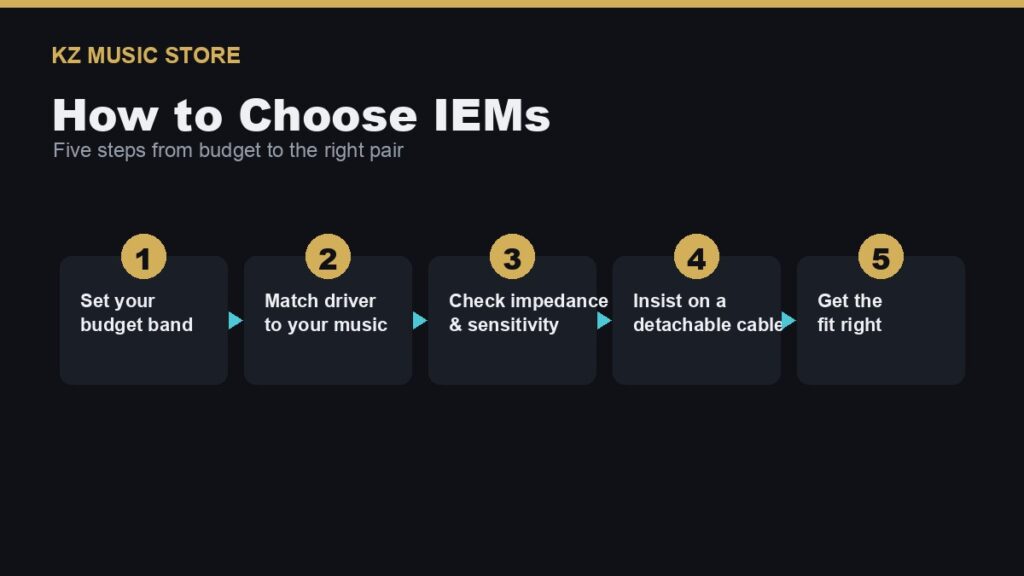
In-ear monitors look intimidating from the outside — driver counts, impedance figures, 2-pin connectors, BA versus dynamic. They’re not. Once you know which four things actually matter, learning how to choose IEMs takes about five minutes, and you’ll avoid both overspending and the classic beginner mistake of buying on driver count alone. This guide walks the decision step by step using real, current models so the advice stays concrete.
If you haven’t browsed models yet, the best budget earphones of 2026 guide is a good companion to read alongside this one.
Step 1: Decide Your Budget Band
Knowing how to choose IEMs starts with money, because it sets your driver options. Under $40 buys a solid single-dynamic pair like the KZ EDX (around $29.90). Around $50–$65 unlocks hybrids such as the KZ ZSN PRO X (around $64.90). At roughly $100 you reach multi-driver monitors like the 10-driver KZ ZS10 PRO X or the 16-BA KZ AS16 PRO. Set the band first; everything else fits inside it.
Step 2: Match Driver Type to Your Music
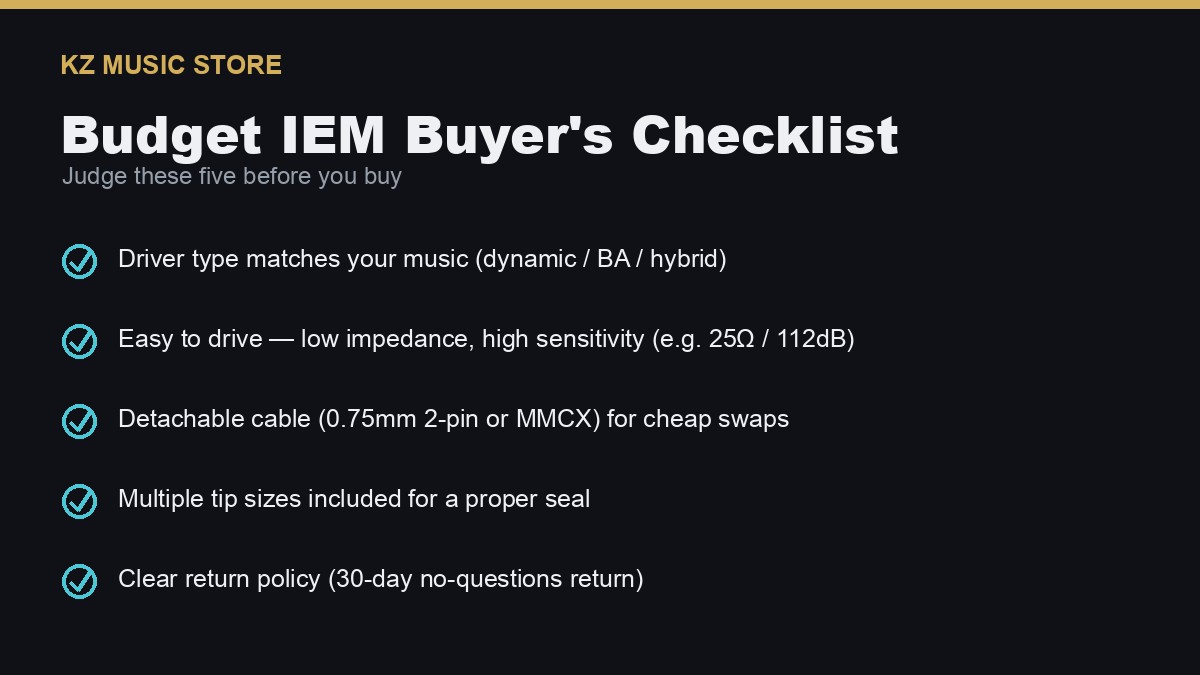
This is the step beginners skip and regret. Driver type shapes the sound more than the driver count:
- Single dynamic driver — warm, full bass and a natural, fun signature. Best for hip-hop, EDM, pop and casual listening. The KZ EDX and KZ Eldar are examples.
- Balanced armature (BA) — fast, detailed treble and mids, lighter bass. Multi-BA designs like the KZ AS16 PRO suit critical listening, classical and vocal-forward genres.
- Hybrid (dynamic + BA) — the all-rounder: dynamic bass plus BA detail. The KZ ZSN PRO X (10mm dynamic + 30095 BA) is the classic do-everything pick.
Pick the type that matches what you listen to most, not the one with the biggest number on the box.
Step 3: Check Impedance and Sensitivity
You want IEMs your source can actually drive. Most budget pairs are built for this — the KZ ZSN PRO X is 25Ω at 112dB sensitivity, which a phone or laptop powers comfortably with no separate amplifier. If a pair lists very high impedance or very low sensitivity, it may need more power than a phone delivers; for a first set, stay with easy-to-drive specs like these.
Step 4: Insist on a Detachable Cable
Cables fail before drivers do. A detachable connector — KZ uses a 0.75mm gold-plated 2-pin standard — turns a snapped wire into a cheap replacement instead of a dead pair, and lets you add a Bluetooth module or upgrade cable later. Treat a fixed cable as a strike against any pair you’re considering.
Step 5: Get the Fit Right
Sound you can’t seal is sound you don’t hear. Use the included tip sizes (KZ ships S/M/L silicone tips) to get a tight, comfortable seal; route the cable over your ear for stability; and if stock tips don’t seal, foam tips are a cheap fix. A good seal also lets you listen at lower, safer volume.
Putting It Together
Run the five steps in order and the shortlist writes itself. A first-time buyer who listens to mixed genres on a phone, for example, lands on a $64.90 hybrid with a detachable cable almost every time. When you’re ready to commit, the KZ IEM review breaks down which specific models deliver the most sound per dollar, and you can browse the full range at KZ Music Store.
Frequently Asked Questions
How do I choose IEMs if I’m a complete beginner?
Learning how to choose IEMs comes down to five steps: set a budget, match driver type to your music, check impedance, insist on a detachable cable, and get a proper fit. A $64.90 hybrid suits most beginners.
Are more drivers always better?
No. Tuning and driver type matter more than count. A well-tuned single dynamic can outperform a poorly tuned multi-BA pair for many listeners.
Do I need an amplifier?
Usually not. Easy-to-drive IEMs like the KZ ZSN PRO X (25Ω, 112dB) run directly from phones and laptops.
What connector should budget IEMs have?
A detachable 0.75mm 2-pin or MMCX connector. It keeps replacement cheap and opens the door to Bluetooth modules and cable upgrades.