Foam earplugs work. They reduce the volume of everything around you – the music, the conversation, the ambient noise – into a muffled, bass-heavy wall of sound that you can stand being around for a few more hours before the ringing starts. They protect your hearing, technically. They ruin the experience, practically.
The best high-fidelity earplugs in 2026 do something different. They use engineered attenuation filters to reduce volume evenly across the frequency spectrum, so what you hear is a quieter version of the actual sound rather than a compressed, filtered approximation of it. At a concert, the music sounds like music. You can hear the mix, follow the arrangement, and maintain conversation between songs. Your hearing is protected; the experience is intact.
For musicians, this distinction matters at a level beyond preference – it’s the difference between monitoring your performance accurately and playing through a low-frequency blur.
Disclosure: this article contains affiliate links. We may earn a commission if you buy through our links, at no extra cost to you.
How High-Fidelity Earplugs Work (vs. Foam)
Standard foam earplugs work through occlusion – they physically block the ear canal and attenuate sound through simple absorption. The problem with this approach is that it attenuates frequencies unevenly. High frequencies are blocked more effectively than low frequencies, which is why foam earplugs make bass-heavy music sound muddy and conversations unintelligible.
High-fidelity earplugs use tuned acoustic filters – small engineered components that sit inside a soft silicone earpiece. The filter creates a precisely calculated impedance to sound at the entry point, which results in even attenuation across the frequency range. The same amount of volume reduction is applied to low, mid, and high frequencies, so the relative balance of the sound is preserved.
The result sounds like turning down the volume on a speaker rather than putting your hand over your ear. At 24dB attenuation with a quality filter, a 100dB concert becomes 76dB – still loud enough to feel energetic, safe enough to sustain for hours without damage.
What to Look for in High-Fidelity Earplugs
Attenuation Level and Curve
The most important spec is not just how much attenuation (in dB) the earplug provides, but how flat the attenuation curve is. A perfectly flat curve would reduce every frequency by exactly the same amount – 18dB at 250Hz, 18dB at 1kHz, 18dB at 4kHz. Real products don’t achieve perfect flatness, but quality filters come close enough that the difference is subtle.
Look for frequency response charts in manufacturer specs. A flat attenuation curve is the indicator of genuine high-fidelity design; an uneven curve means the sound character changes, not just the volume.
Attenuation Range
Different use cases need different attenuation:
– 15-20dB: Suitable for moderately loud environments – band rehearsals, sports events, busy venues
– 22-25dB: Concert and live music standard – covers the typical 95-105dB of a loud live show
– 27dB+: Extremely loud environments – heavy equipment, motorsports, very loud clubs
Interchangeable filter systems let you adjust attenuation to context – use lighter filters at a jazz venue, heavier at a festival.
Fit and Comfort
An earplug that doesn’t seal properly doesn’t attenuate properly. Most high-fidelity earplugs come with multiple ear tip sizes (S/M/L and sometimes XS). Finding the right size matters – too small and the seal is incomplete; too large and they’re uncomfortable over time.
Silicone flanged designs (the most common for high-fidelity earplugs) are more comfortable over long sessions than foam and create a more consistent seal.
Reusability and Carry
Foam earplugs are single-use or a few uses. High-fidelity earplugs are designed for hundreds of uses with proper care. A carrying case – ideally one small enough to attach to keys or fit in a pocket – determines whether you actually have them with you when you need them.
Best High-Fidelity Earplugs 2026: Top Options
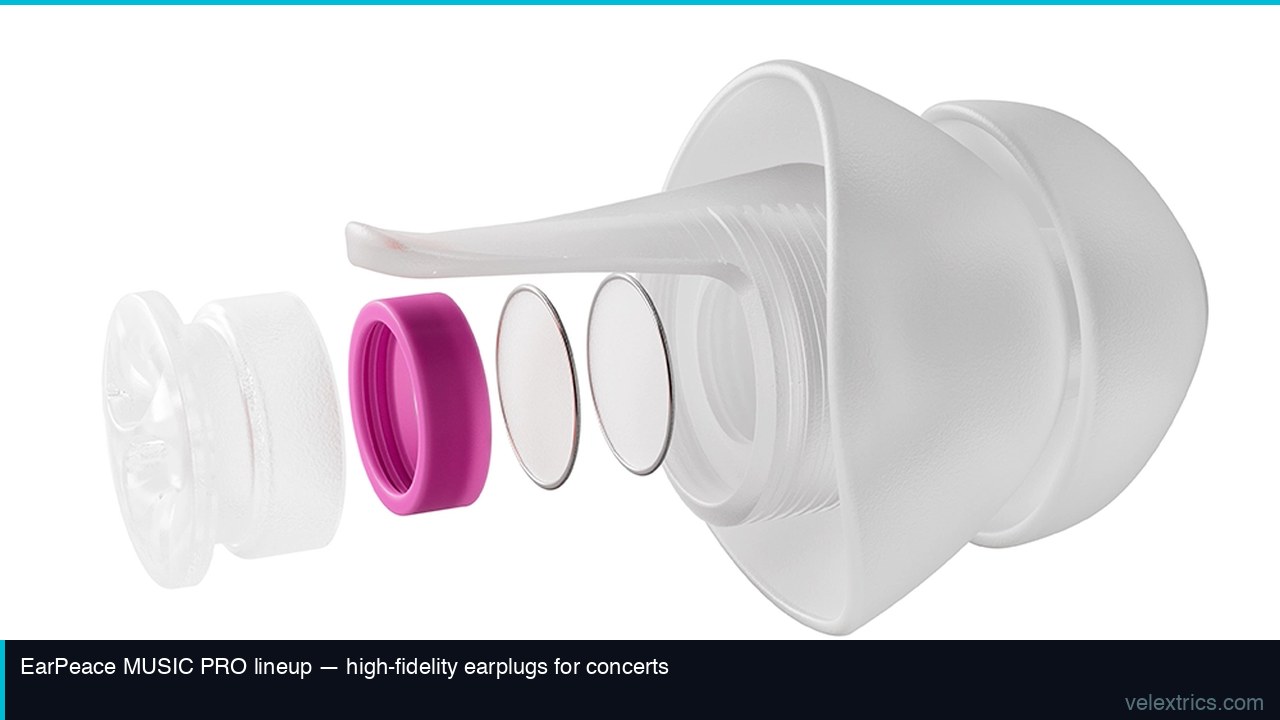
EarPeace MUSIC PRO ($42.95) – Best Overall for Live Music
EarPeace’s MUSIC PRO is the flagship model for musicians and concert-goers, using 24dB PRO attenuation filters and patented Attenuated Filter Technology developed across four patents. Featured in Forbes, Wired, and Rolling Stone, it’s built its reputation in the live music space rather than in industrial or travel categories.
The MUSIC PRO ships with multiple tip sizes and includes a compact carrying case. The interchangeable filter system lets you swap between filter strengths for different volume environments.
At $42.95, it sits in the mid-range of the high-fidelity earplug market and competes directly with options from Alpine and Loop at similar price points.
EarPeace EVERYDAY ($34.95) – Best for Daily Use
The EVERYDAY model targets a broader use case: offices, gyms, social settings, travel, and daily noise sensitivity. At 22dB with Pro filters, it provides meaningful protection at a slightly lower attenuation level than the MUSIC PRO.
For someone who attends concerts occasionally but primarily wants ear protection for commuting, open-plan offices, or gym environments, the EVERYDAY’s profile and slightly lower price make more sense than the MUSIC PRO.
EarPeace MUSIC ($31.95) – Entry Point
The MUSIC model is the lowest-cost entry point in the EarPeace lineup. For occasional concert-goers who want better than foam without the full investment of the PRO model, it provides the core high-fidelity benefit at a more accessible price.
Alpine MusicSafe Pro (~$40) – Competitor Option
Alpine’s MusicSafe Pro is a well-regarded alternative with an interchangeable filter system offering three attenuation levels in one set of earplugs. The three included filters give you more attenuation flexibility than a single-filter option. Widely available in music stores.
Loop Experience (~$35) – Design-Led Alternative
Loop Experience earplugs have strong brand recognition and distinctive visual design. Performance is comparable to options in the same price range. If aesthetics matter and you want something that draws less attention at concerts, Loop’s design approach is relevant.
EarPeace vs. Foam: The Honest Comparison
| Factor | EarPeace MUSIC PRO | Foam Earplugs |
|---|---|---|
| Sound quality | High-fidelity – even attenuation | Muffled – bass-heavy distortion |
| Attenuation | 24dB flat | Up to 33dB but uneven |
| Comfort (long use) | High (silicone, multiple sizes) | Low (pressure build-up) |
| Reusability | Hundreds of uses | Single/few uses |
| Cost | $42.95 | $0.10-0.50/pair |
| Carry | Pocket case | Individual wrapping |
The cost comparison favors foam for infrequent use. For anyone attending concerts more than a few times a year, the math inverts quickly – EarPeace’s cost per use drops to pennies over a year of regular use.
Why Hearing Protection Matters
Noise-induced hearing loss is permanent. The hair cells in your cochlea that convert sound to neural signals don’t regenerate – damage to them accumulates over your lifetime without recovery. A single very loud concert can cause temporary threshold shift (the ringing you hear after a show); repeated exposure without protection leads to permanent threshold shift.
At 100dB – a typical loud concert – hearing damage begins within 15 minutes of unprotected exposure. At 110dB – a very loud festival stage – damage begins in under 2 minutes. High-fidelity earplugs at 24dB attenuation bring these levels down to ranges that can be sustained for hours without risk.
For musicians who rehearse and perform regularly, cumulative exposure is the primary concern. Professional musicians have substantially higher rates of tinnitus and hearing loss than the general population – using proper attenuation for every loud session is the only practical mitigation.
→ Get EarPeace MUSIC PRO – Free Shipping
Frequently Asked Questions
Will high-fidelity earplugs change how the music sounds?
Good high-fidelity earplugs change the volume, not the character. At 24dB attenuation, the music sounds quieter but preserves tonal balance, stereo imaging, and dynamics. It takes one or two concerts to adjust to wearing them – after that, going without feels uncomfortably loud.
Can I wear high-fidelity earplugs while playing an instrument?
Yes. Musicians wear in-ear monitors or high-fidelity earplugs during rehearsal and performance. The key is finding the attenuation level appropriate for your instrument and position – musicians closest to loud drum kits or amplifiers typically need more protection than those in quieter positions.
How do I clean EarPeace earplugs?
Remove the filter from the silicone body. Wash the silicone tips with mild soap and water and let dry completely. Clean the filter housing with a dry cloth – do not submerge the filter assembly in water.
Are high-fidelity earplugs good for sleeping?
No. Sleep earplugs prioritize maximum attenuation and comfort for stationary use. High-fidelity concert earplugs are designed for dynamic sound environments. Foam or purpose-built sleep earplugs are better for that use case.